A long-time customer in the electrical connector manufacturing industry needed to increase the output of their foil shielding operation. Their existing high-speed foil applicator machine could process jack modules at 25 parts per minute, but growing production demands required a faster, high-throughput solution. It needed to handle two jack module styles at higher speed. The customer turned to SDC to engineer an upgraded custom automated machine that could handle two styles of jack modules at up to 50 parts per minute, without sacrificing precision or quality.
The challenge was not just speed. The two jack styles each require a different foil shape, application method, and wrap pattern. Changeover between the two had to remain fast and require minimal tooling. Any solution also needed to handle reel-to-reel variation in foil placement, inspect for correct positioning, and sort parts accurately into good and reject bins.
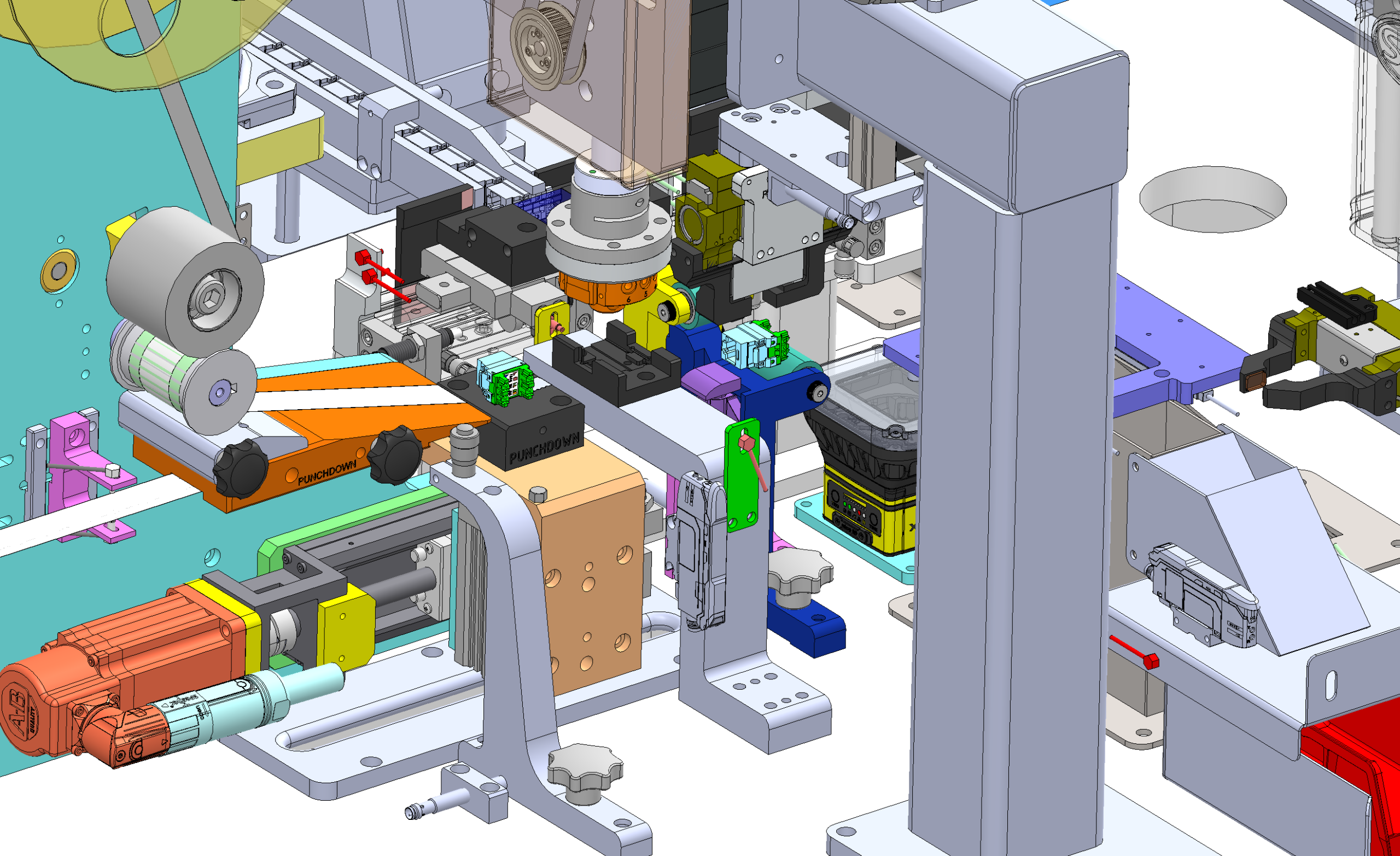
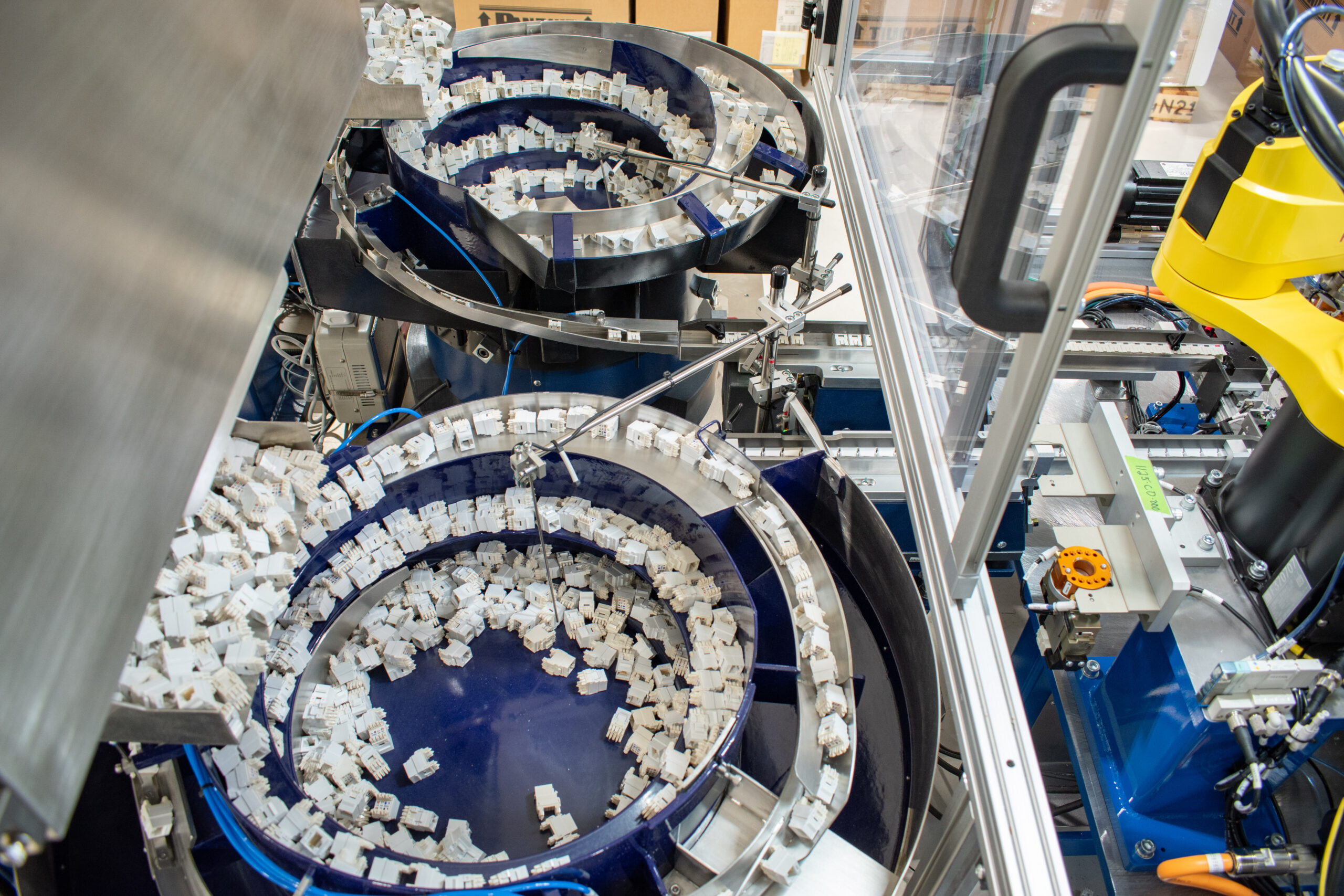
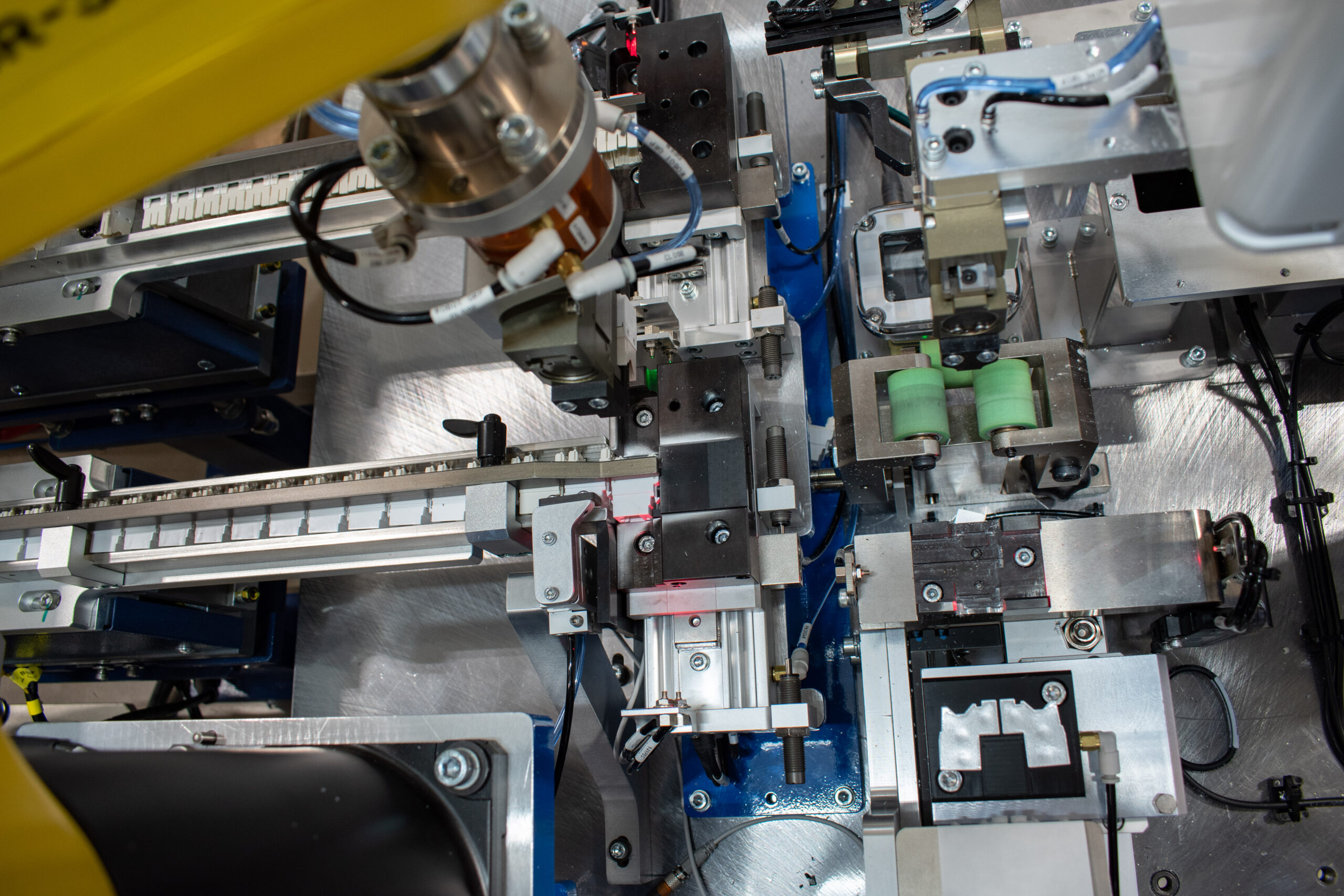
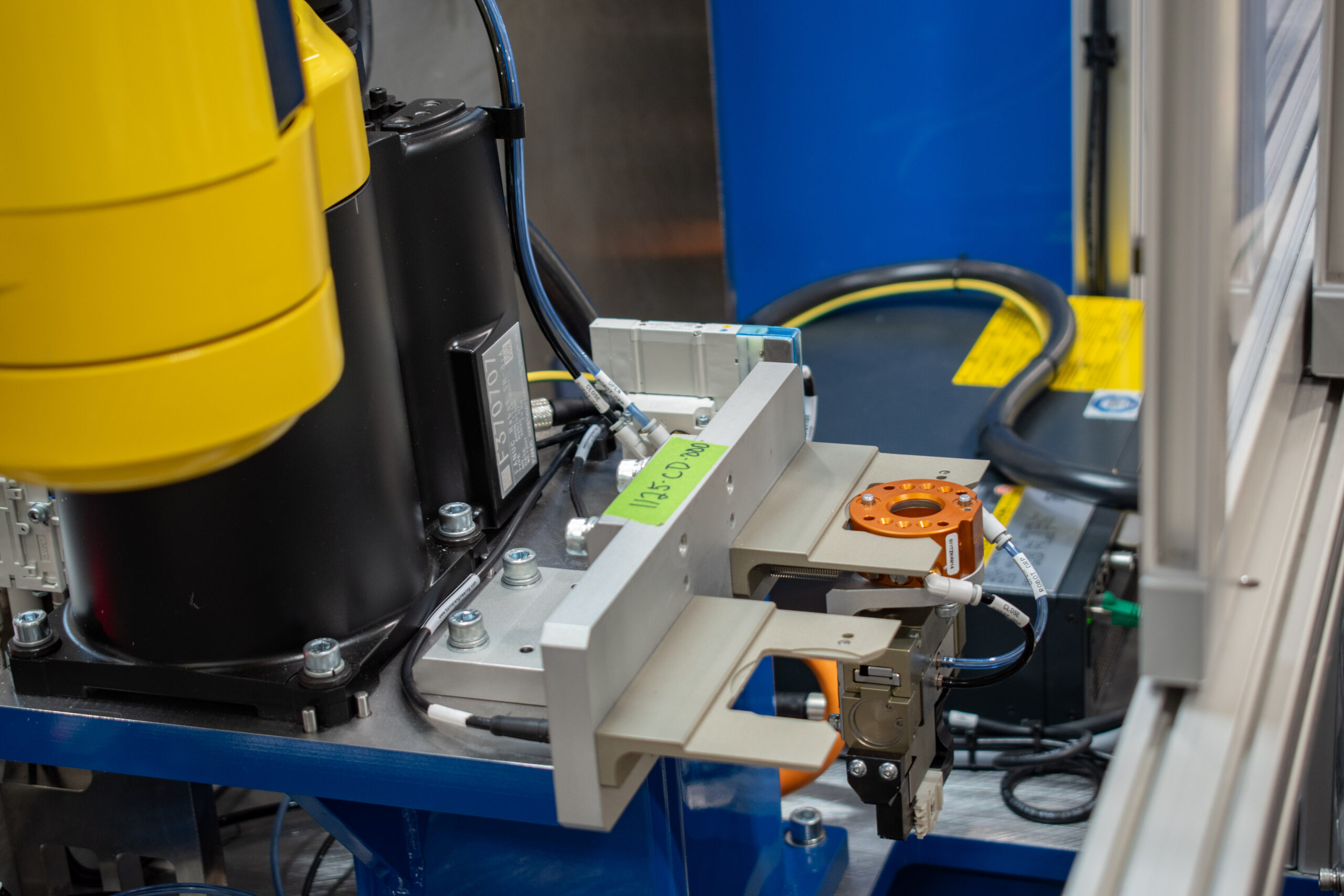

The core challenge with doubling throughput was motion. The existing machine relied on a single SCARA robot to handle jack pickup, foil application, and bin sorting in sequence. At 25 parts per minute, that workflow was manageable. At 50 parts per minute, the robot would become a bottleneck no matter how fast it moved.
The solution was to divide the work. Two SDC servo-driven pick-and-place units took over the downstream steps — foil wrapping and final sortation. As a result, the SCARA robot could focus exclusively on picking jacks and placing them onto the foil applicator. Each axis of motion was optimized independently, so the overall cycle ran faster without overworking any single component.
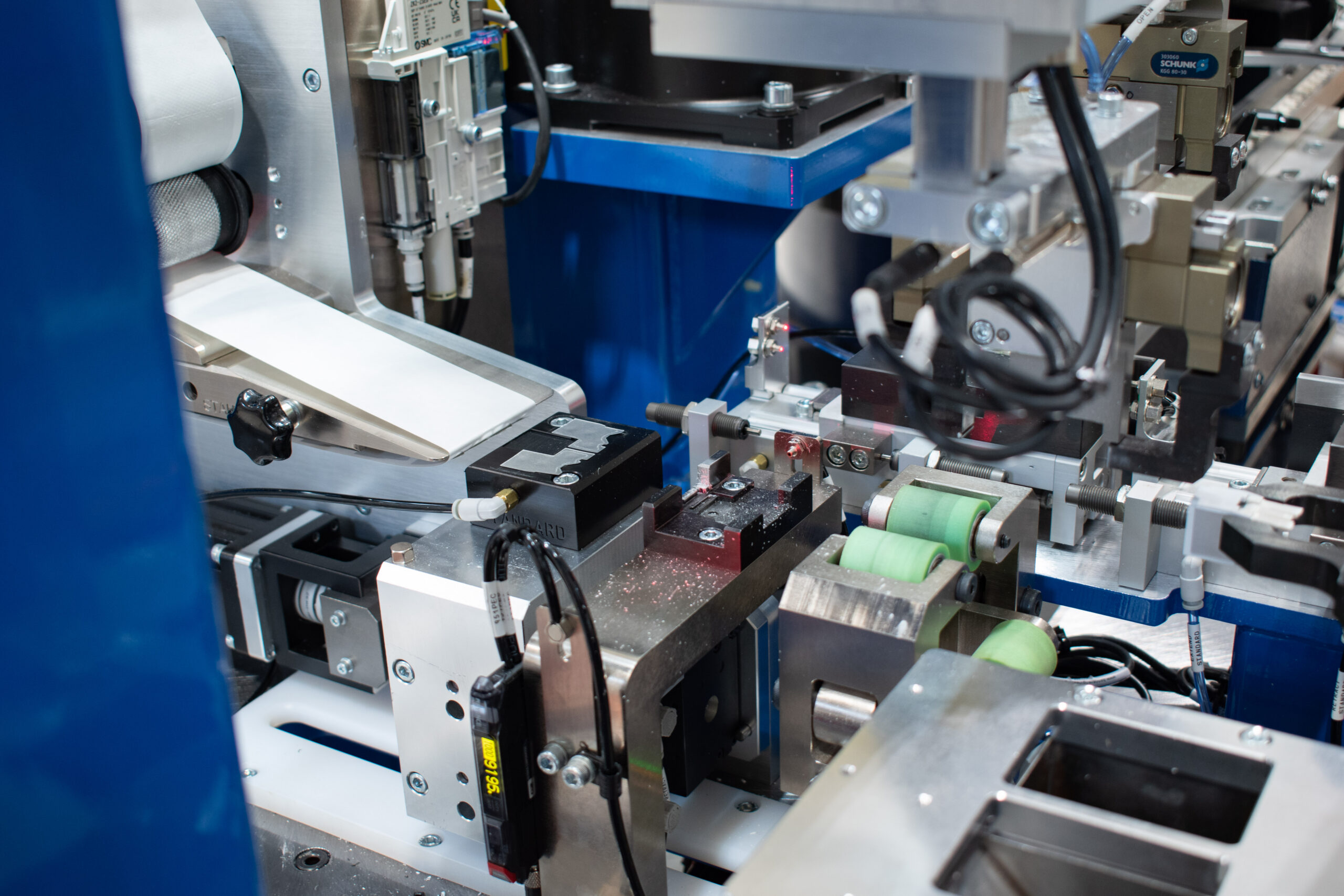
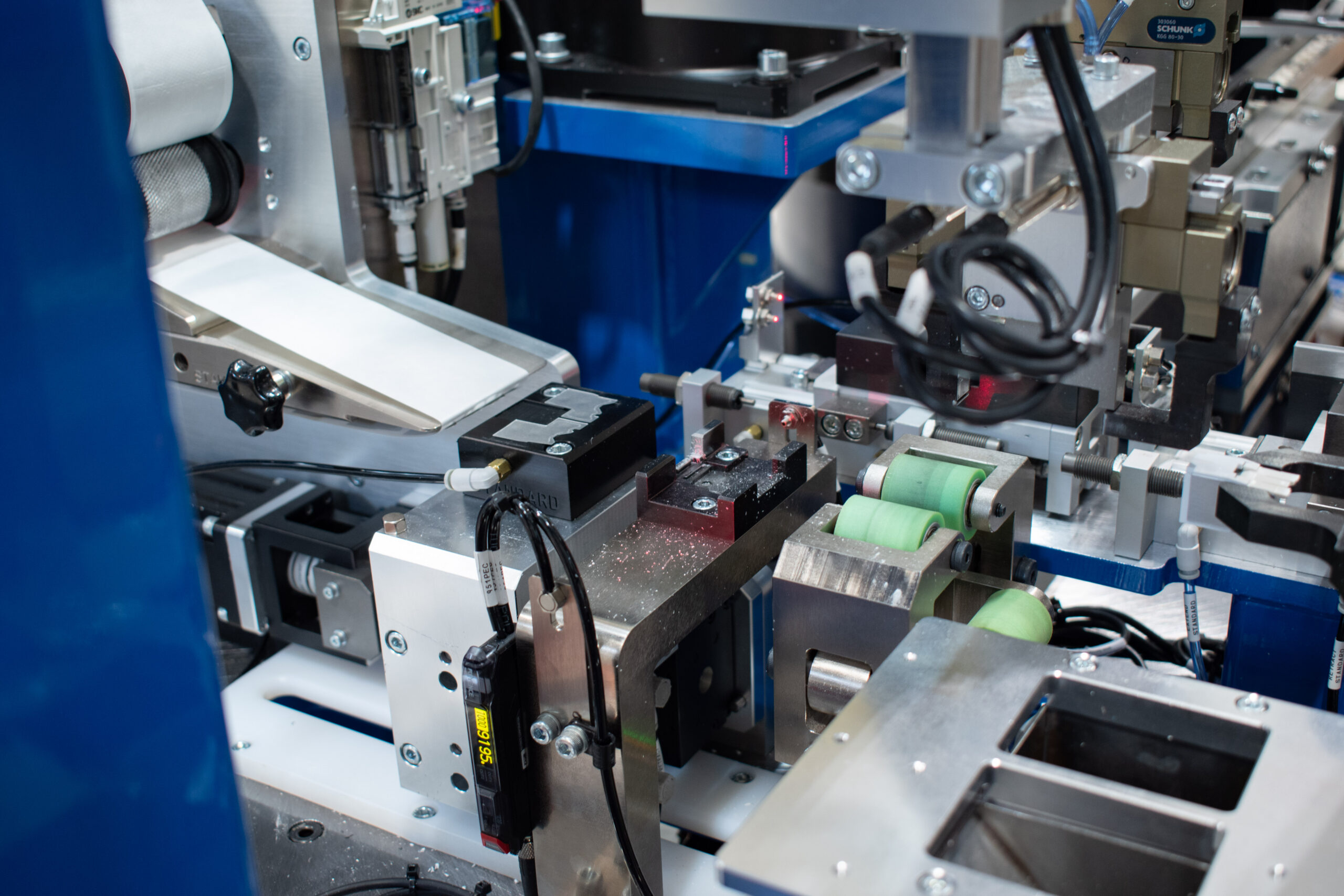
SDC engineered an upgraded foil applicator assembly machine built on the proven foundation of a previous generation SDC design. The result is a fully automated robotic cell capable of processing two jack module styles at up to 50 parts per minute. The new machine kept the core architecture — welded steel frame, interlocked safety guarding, pneumatic control system, and Allen-Bradley PLC. Significant changes were made to the motion system, vision logic, and mechanical components to hit the higher production target.
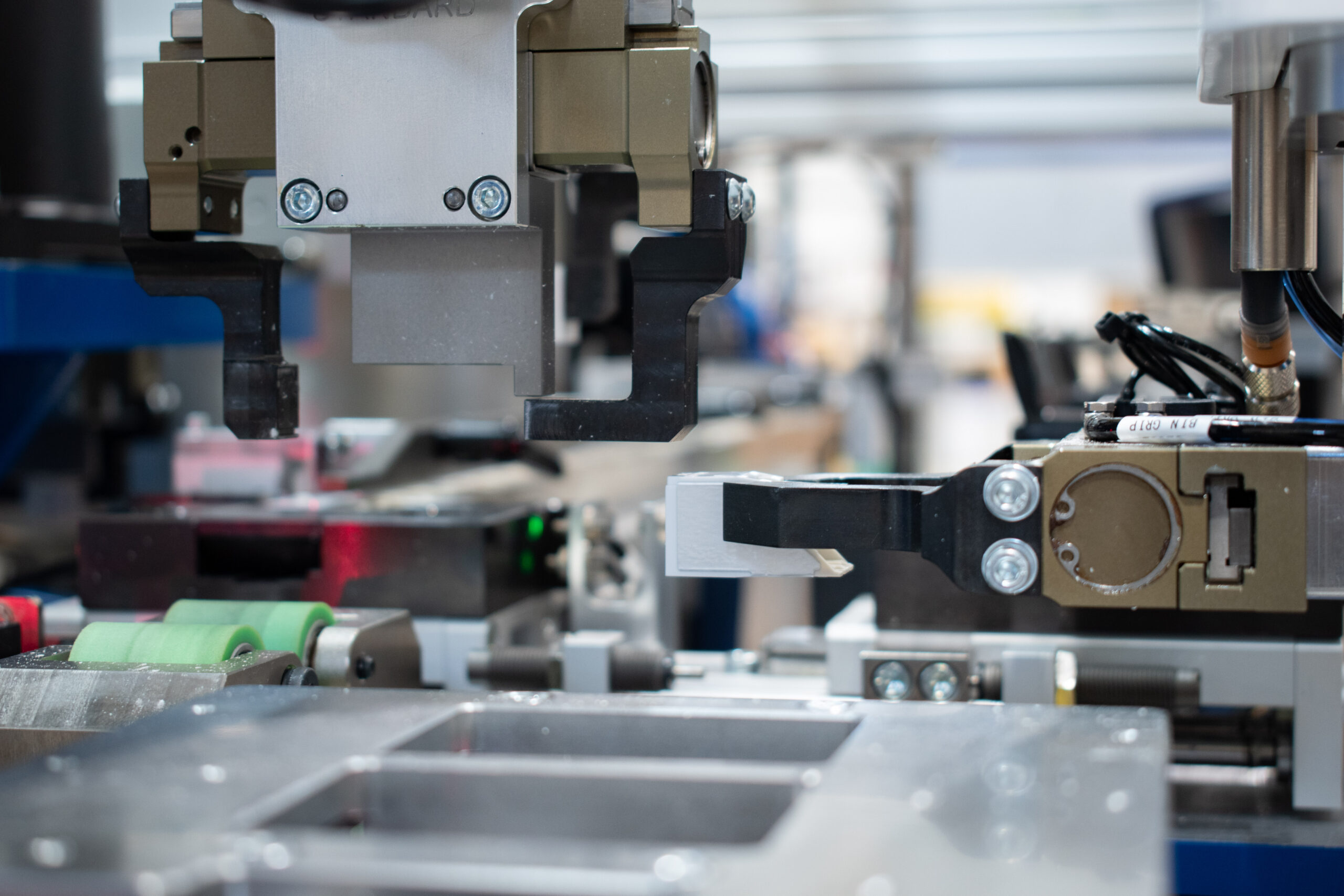
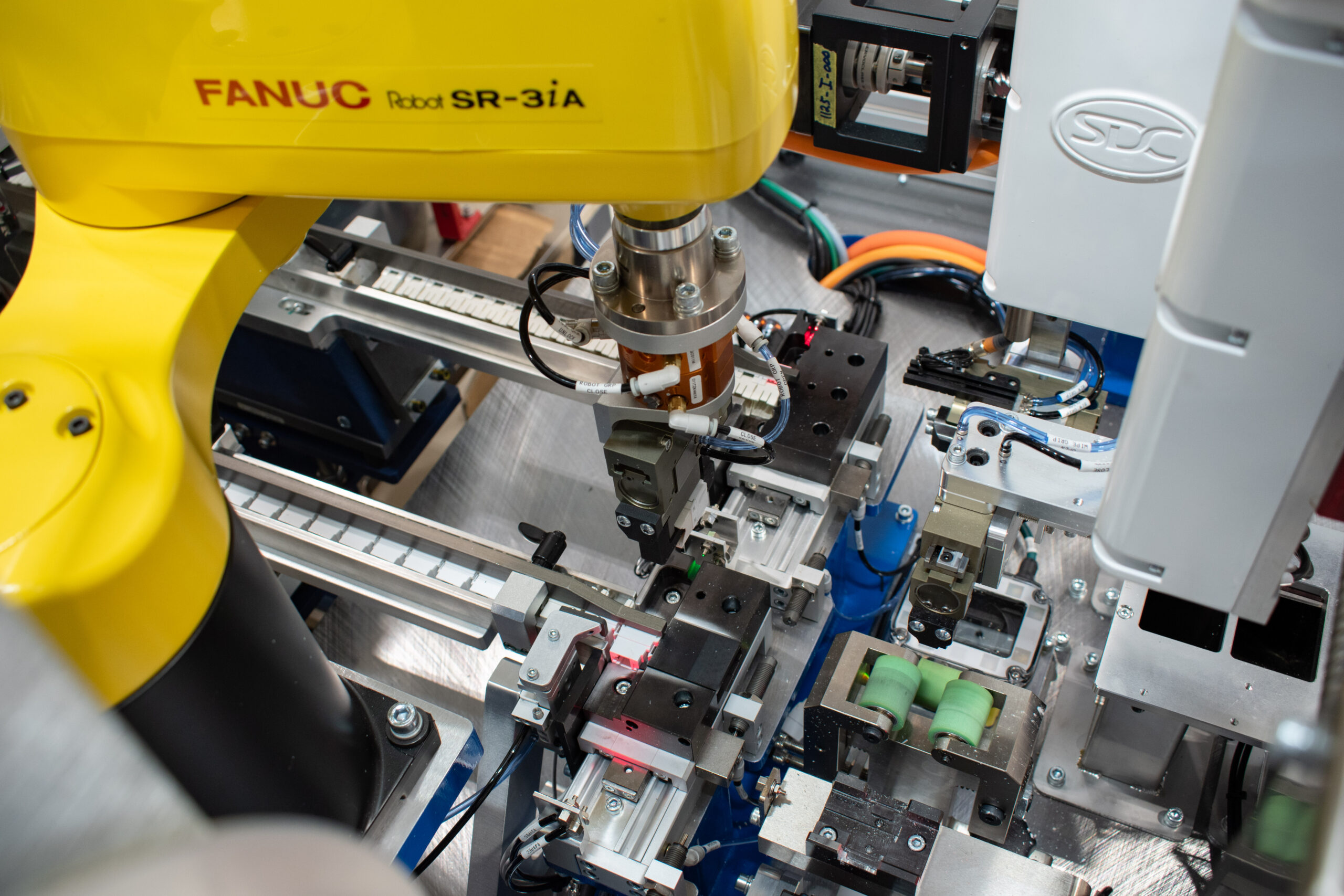
The robotic integration centerpiece of this automated robotic cell is the FANUC SCARA robot. SDC is a FANUC Authorized System Integrator (FANUC ASI), and this machine reflects that expertise. The robot uses an automatic tool changer and two jack grippers. This enables automated robotic tooling changeover between the two jack styles without manual intervention. The SCARA robot’s scope was narrowed compared to the prior machine. This kept it running at maximum efficiency within its portion of the cycle.
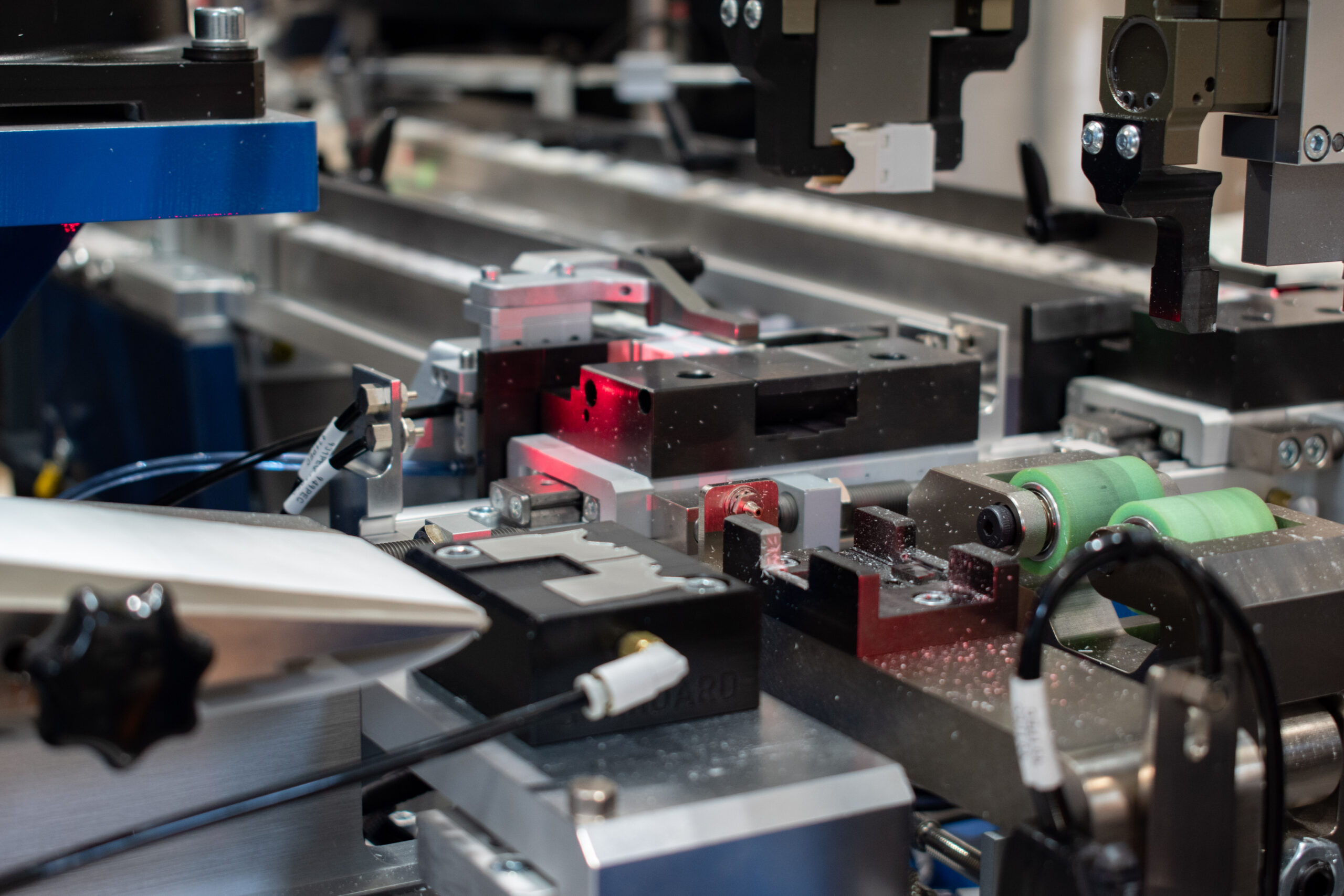
Two SDC two-axis servo-driven pick-and-place units handled the downstream work. The first unit picked up each jack after the foil adhered to the bottom, then passed it through the foam wrapping rollers to wrap the foil around the sides of the jack. The second unit picked the finished jack from the inspection station and deposited it into either the good parts bin or the reject bin based on vision results. Both units featured manual quick-change couplings for fast product changeover.
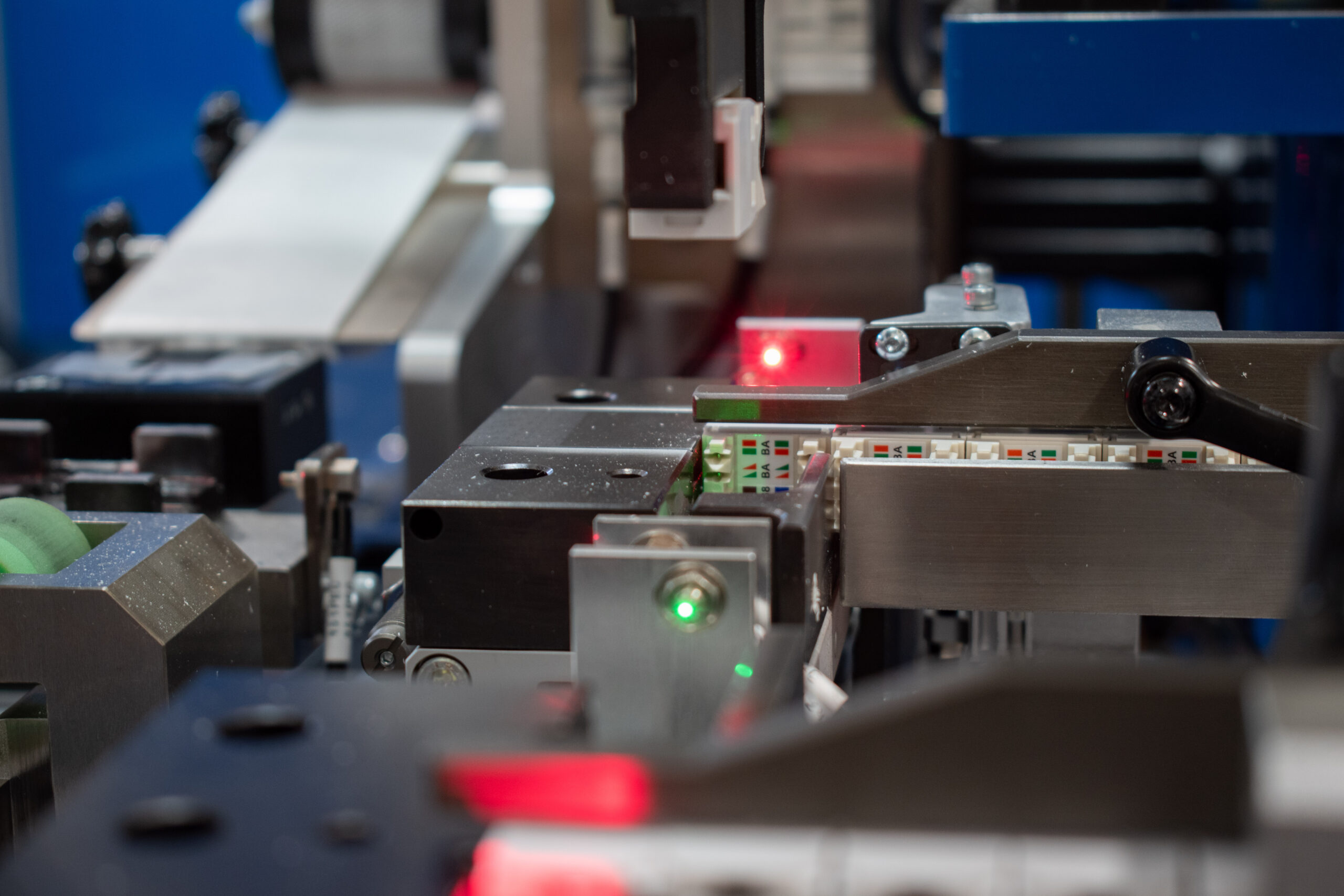
The automatic vision inspection system was updated to reflect a key customer-driven change: all foil is now silver across both jack styles. SDC reconfigured the vision logic and color inspection camera accordingly. The system performs inline inspection of each finished jack. It checks the position and placement of the foil and triggers a reject if results fall outside of tolerance. A dedicated display shows inspection results in real time for operator awareness.
Drawing on experience with the earlier machine, SDC incorporated several mechanical improvements. The team redesigned the anvil plate to eliminate flexing during foil grabbing and adjusted the strip sensor to function reliably across both product types. SDC also raised the payout motor to accommodate larger foil reels and replaced the take-up motor with a more reliable unit.
Additionally, improved tote-filling behavior distributes parts more evenly and prevents spillage. SDC updated machine restart logic to prevent a reject part from inadvertently landing in the good parts chute.
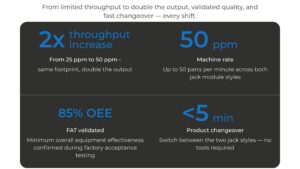
The upgraded machine achieved a high-throughput production rate of up to 50 parts per minute — double the output of the previous generation. The customer targets 50 parts per minute, 24 hours per day, 280 days per year. The machine was validated to a minimum 85% OEE during Factory Acceptance Testing.
This machine incorporates two SDC Servo pick-and-place units. These are SDC standard products — pre-engineered, two-axis servo-driven transfer systems refined across multiple machine programs. Using proven standard products reduced engineering risk and shortened build time. It also gave the customer confidence in a component with a known performance history. The quick-change gripper couplings on each unit support the fast product changeover requirements of this application.
This project shows what SDC does when a customer needs more from a machine they already trust. Rather than starting from scratch, SDC built on a proven design and targeted the bottleneck — motion throughput. Two SDC servo pick-and-place units broke up the motion workload and unlocked a 2x increase in production rate. Together, updated vision logic, improved mechanical reliability, and tighter sortation controls came with it. The upgraded assembly machine gives the customer the speed and consistency they need. For SDC, it’s another example of how precision automation and a deep understanding of the customer’s process leads to machines that perform, day in and day out.
A: A high-speed foil applicator machine feeds jack modules from a hopper, uses a robot to pick each jack and place it onto a foil strip, then wraps the foil around the jack using rollers. A vision system checks placement accuracy, and a sortation system separates good parts from rejects. In this machine, the work is divided across a SCARA robot and two servo pick-and-place units to reach speeds of up to 50 parts per minute.
A: A servo pick-and-place is a two-axis, servo motor-driven transfer system that moves parts from one location to another with high speed and repeatability. By offloading downstream steps from the primary robot, a pick-and-place allows each component in the machine to focus on a smaller portion of the cycle. This parallel motion architecture is what enabled this machine to double throughput without a complete redesign.
A: Yes. This machine handles two jack styles in separate production batches. Each style has its own dedicated feeder. The SCARA robot uses an automatic tool changer to switch grippers, and the pick-and-place units feature quick-change couplings. Changeover between jack types takes under five minutes and requires no special tooling.
A: Automatic vision inspection in this machine serves two functions. First, it identifies the correct foil placement coordinates on the applicator pad, accounting for reel-to-reel variation in foil position. Second, inline inspection after wrapping verifies that the foil is within tolerance before the part is accepted. Parts that fail are diverted to automated defect sorting — deposited into an enclosed reject bin separate from the good parts tote. This approach ensures consistent quality at high production speeds without slowing the machine cycle.
A: OEE (Overall Equipment Effectiveness) measures how efficiently a machine runs compared to its theoretical maximum by factoring in availability, performance, and quality. An OEE of 85% means the machine is productive 85% of the time it is scheduled to run. For high-volume production operations running 24 hours a day, a strong OEE target ensures that the machine delivers on its rated throughput over the long term, not just during testing.