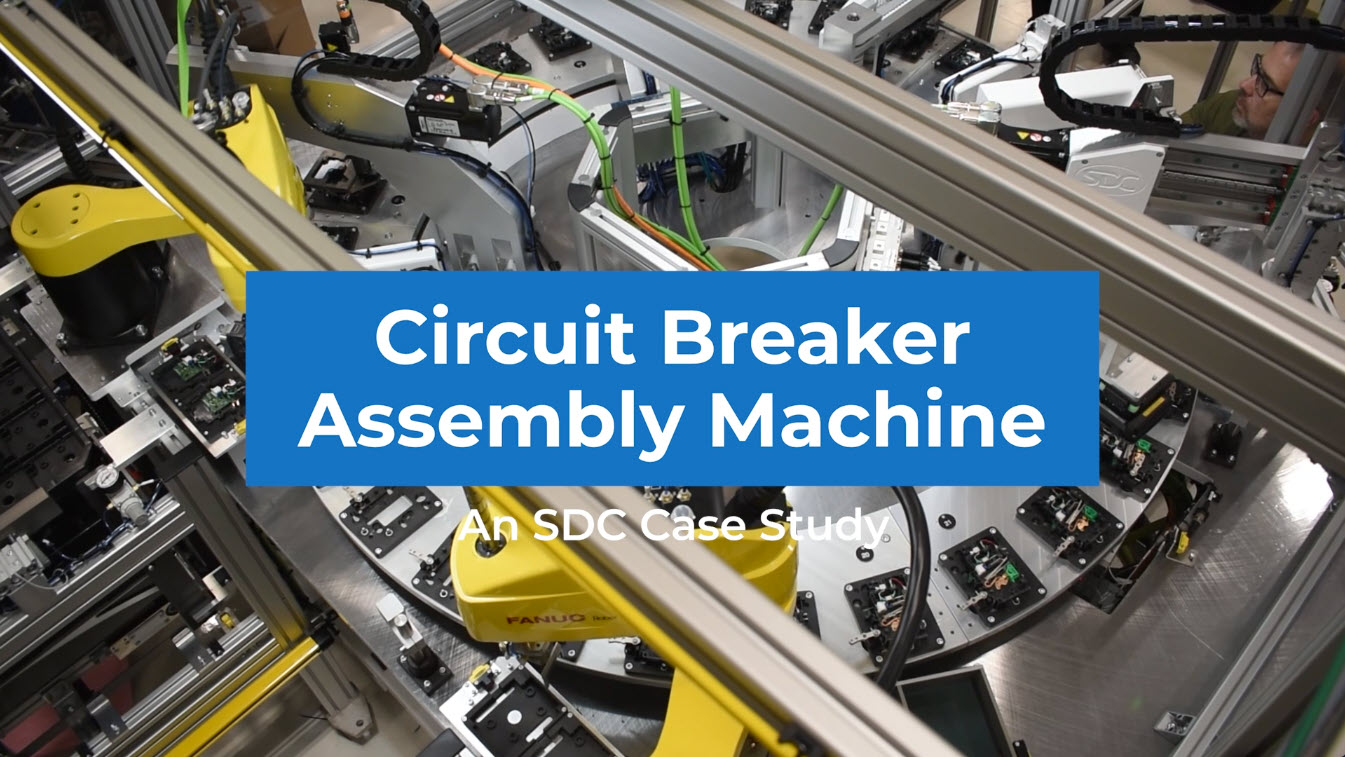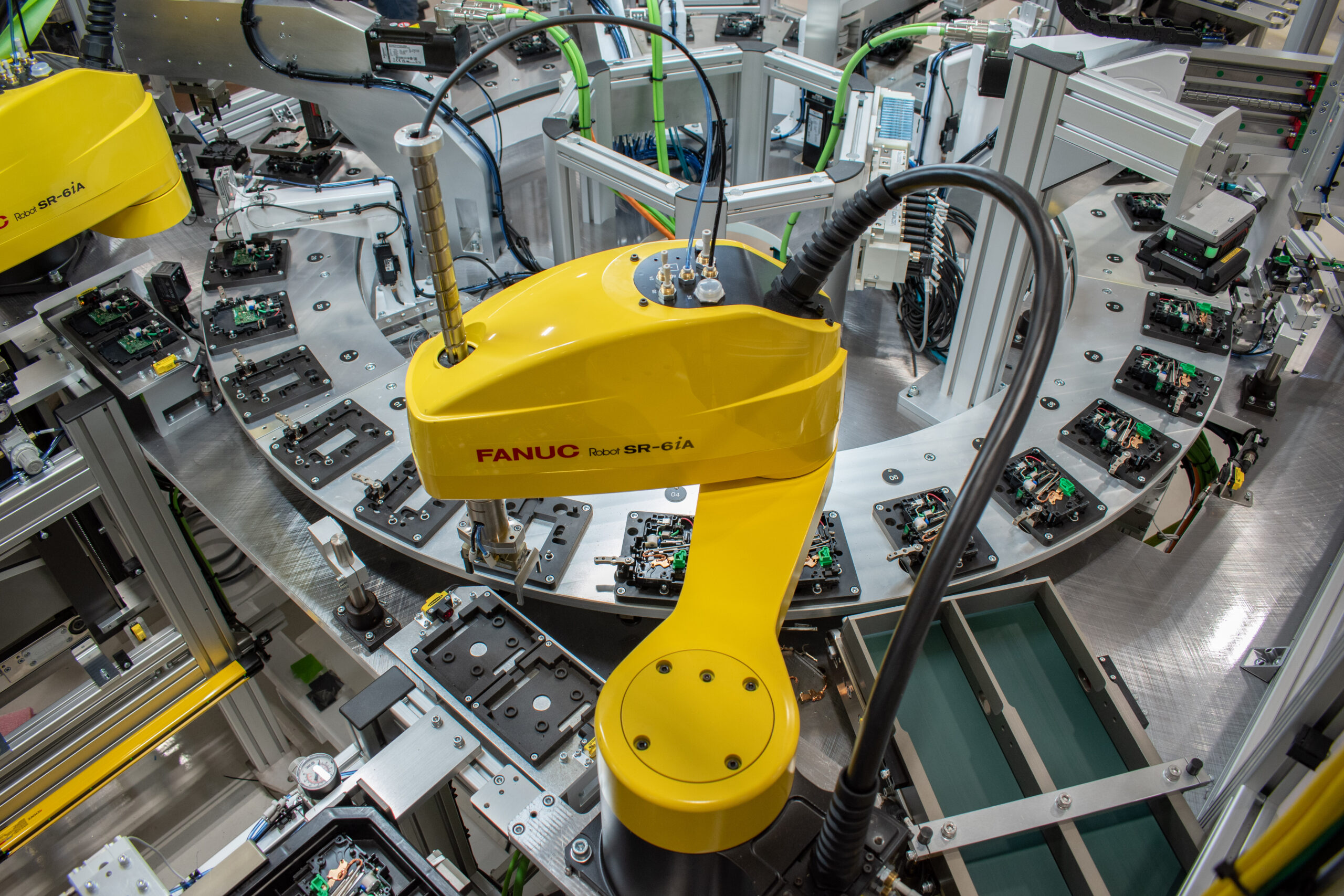
A manufacturer of electrical protection devices partnered with SDC to build a fully automated circuit breaker assembly machine. The customer needed to assemble several small parts, including a base and circuit board, an armature, and a current path assembly, into one finished part. Doing this by hand was slow and made it hard to keep quality consistent from part to part. SDC needed to design a machine that could handle nearly every step, from parts feeding through final inspection, at high speed with minimal operator involvement.
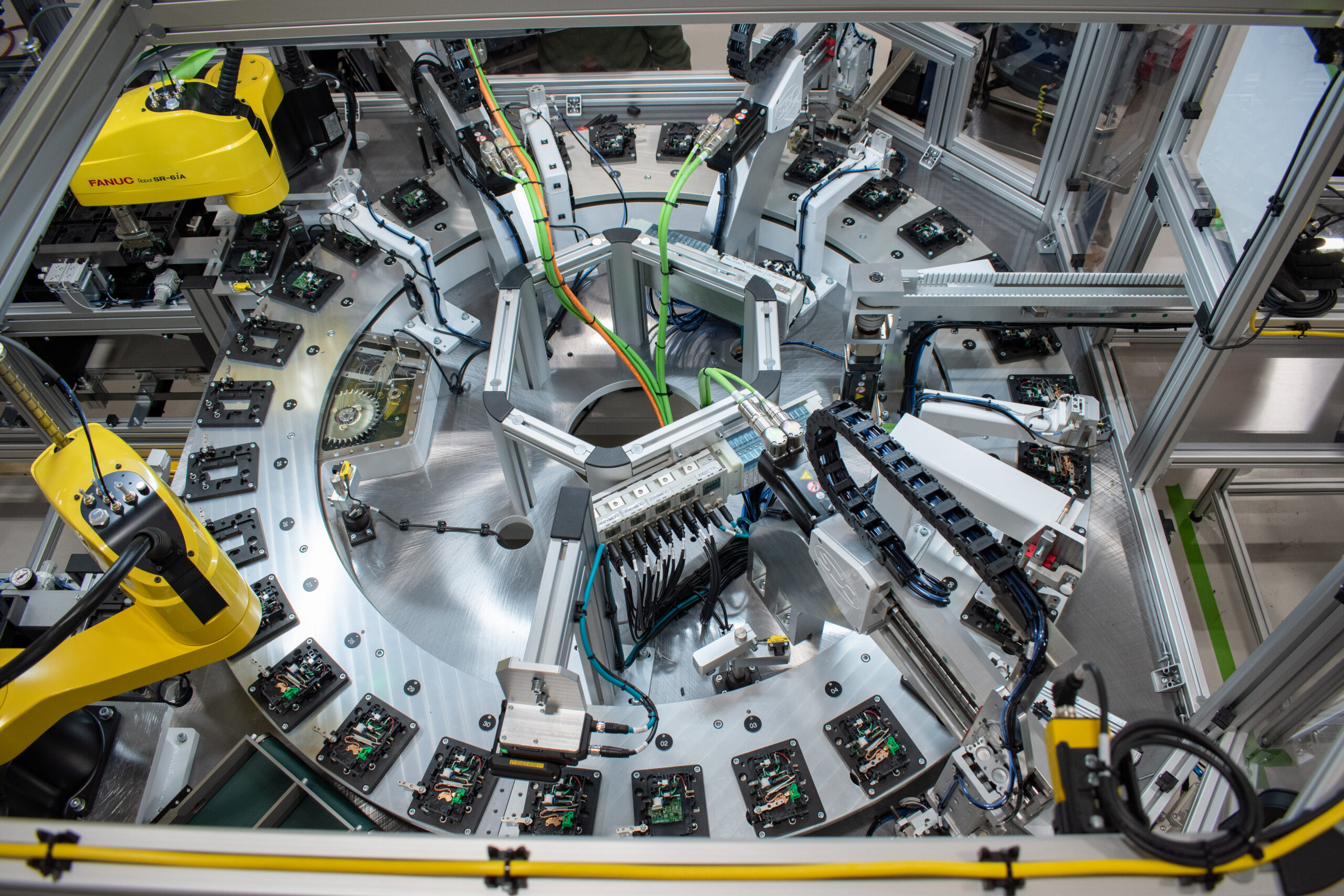
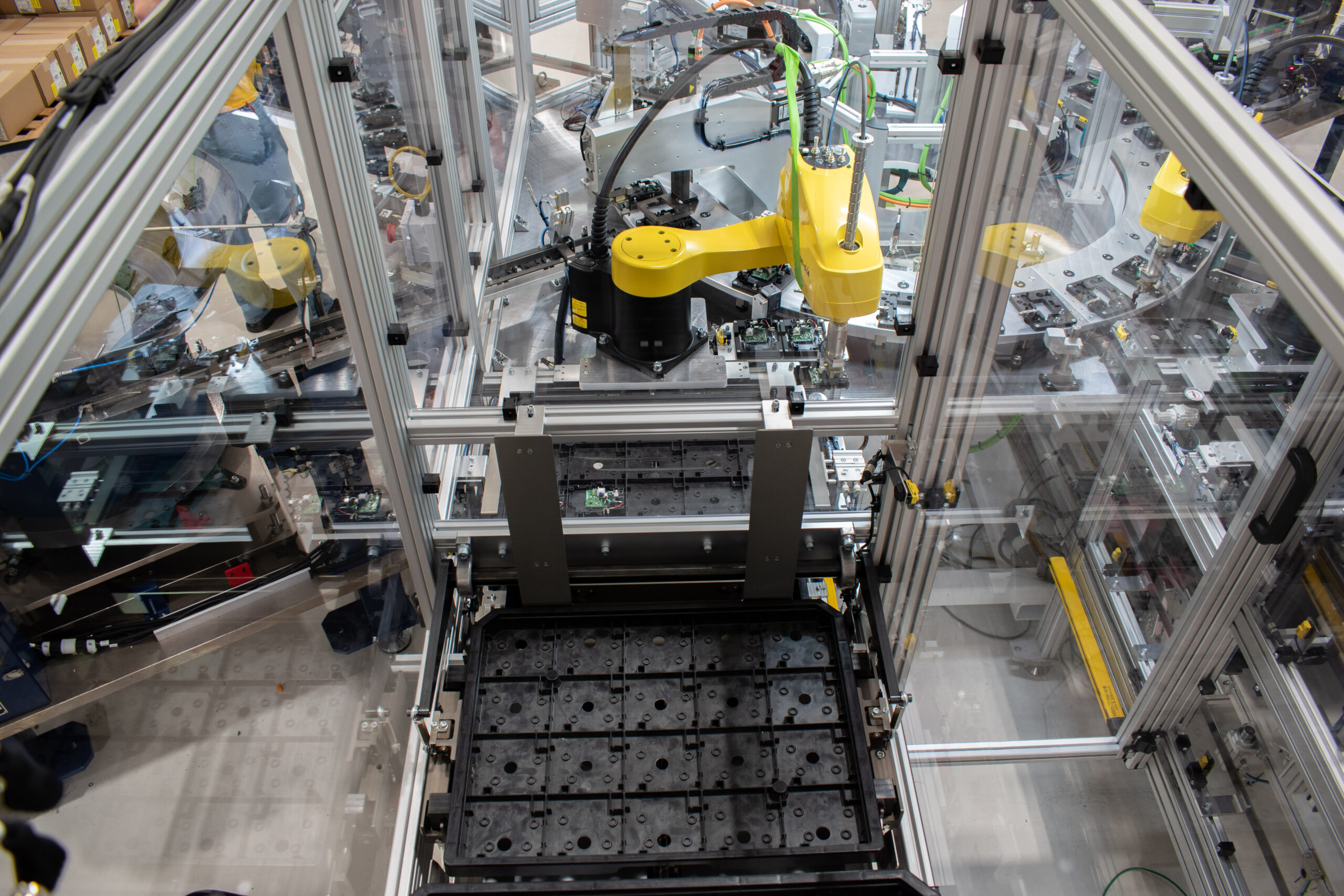
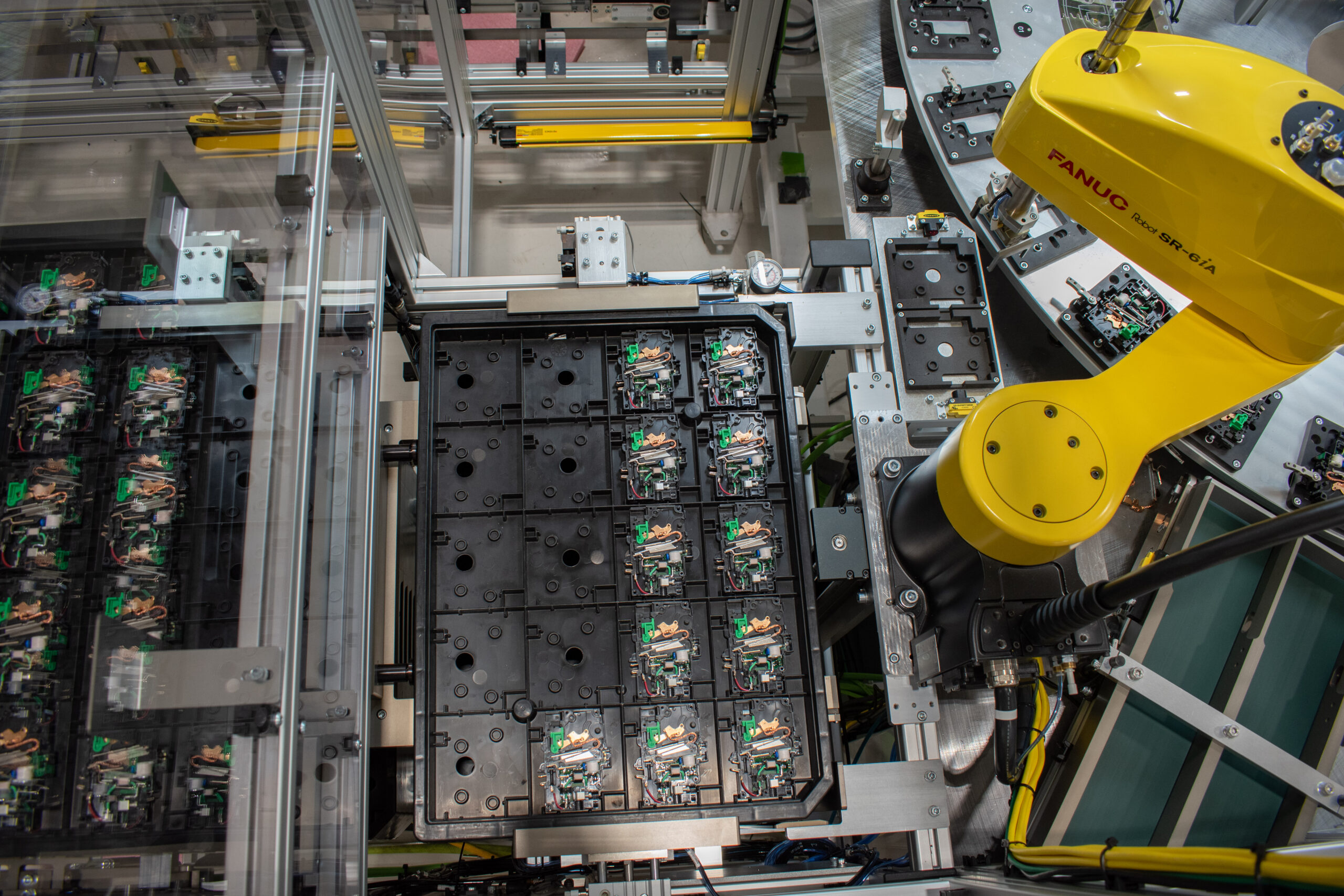
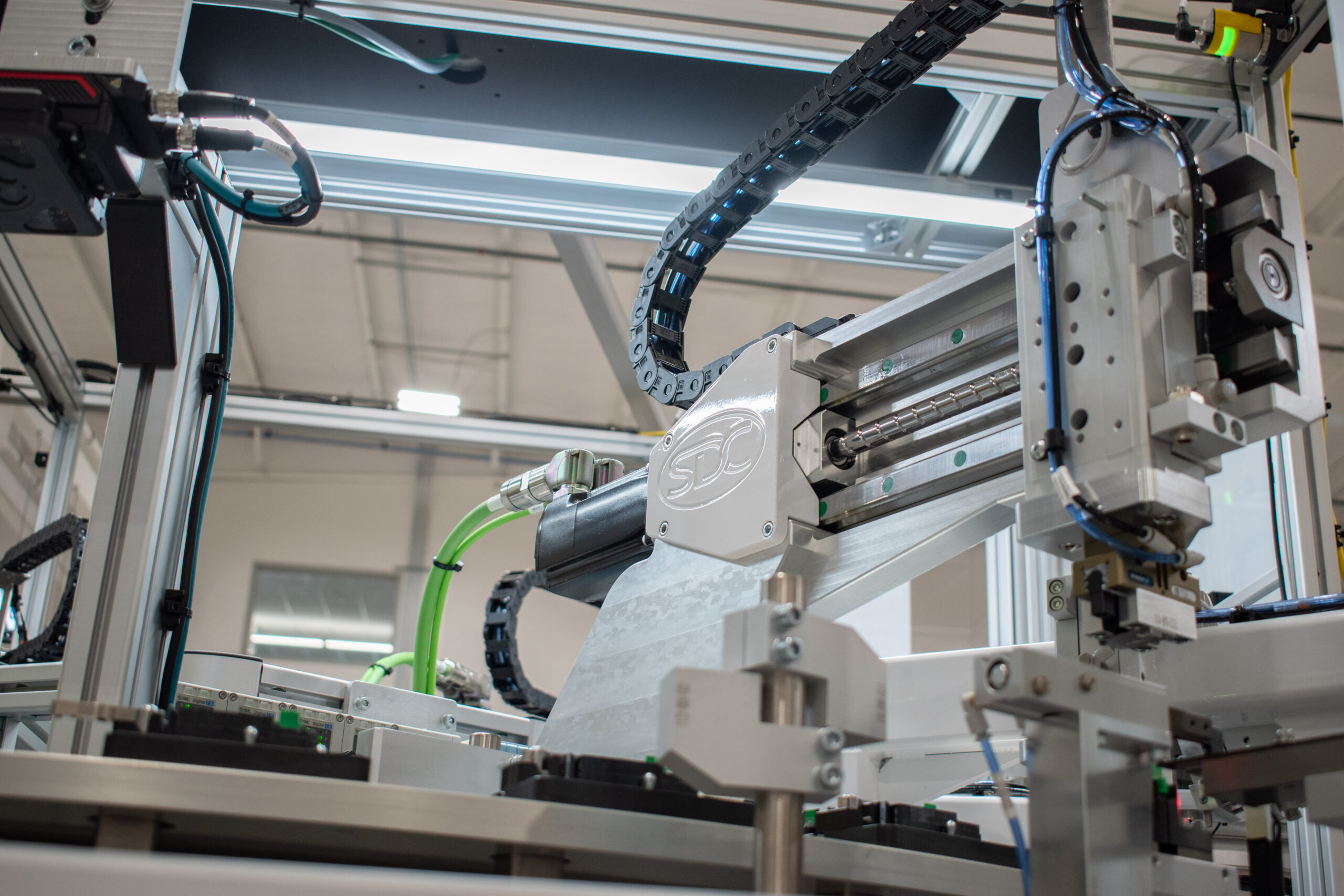
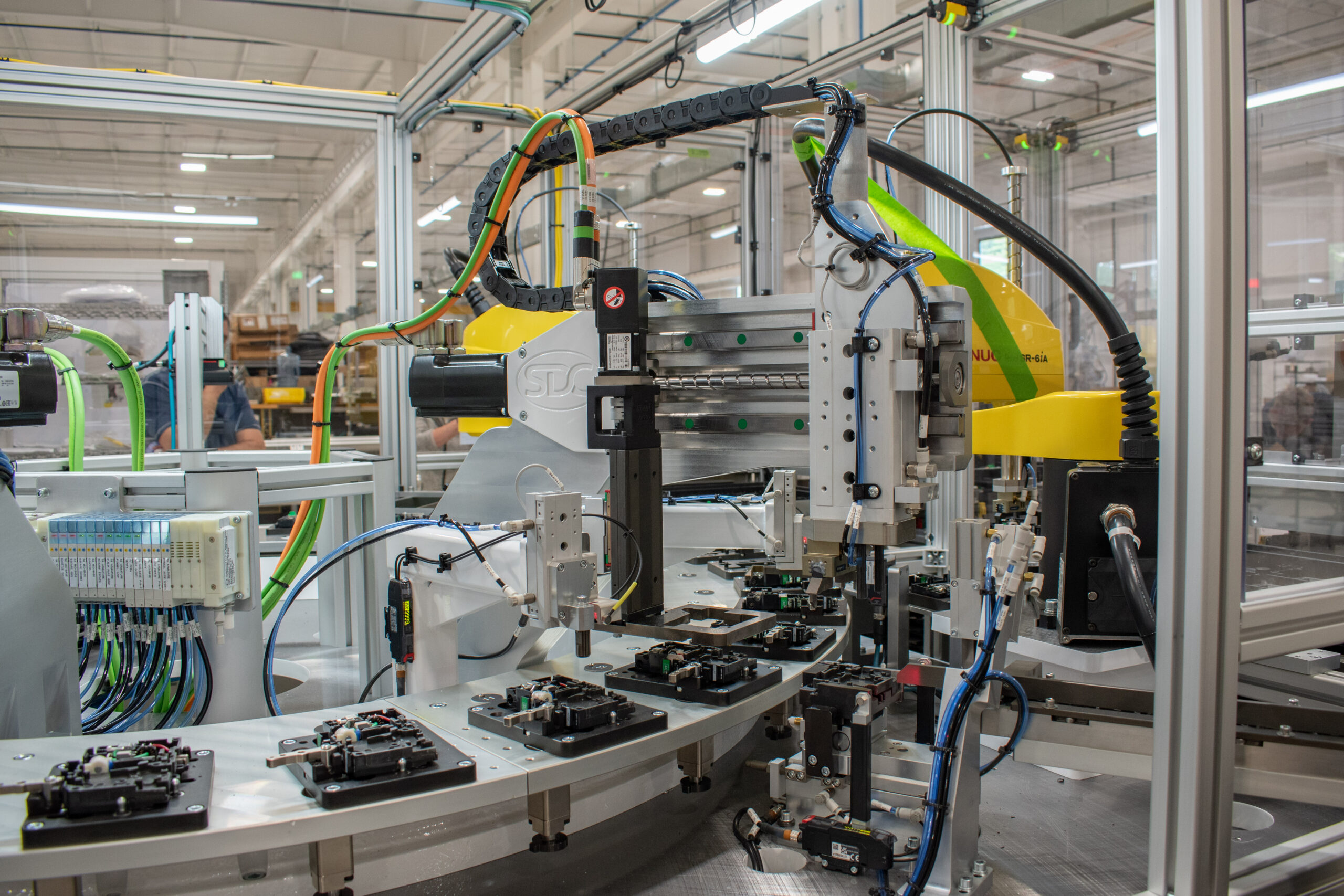
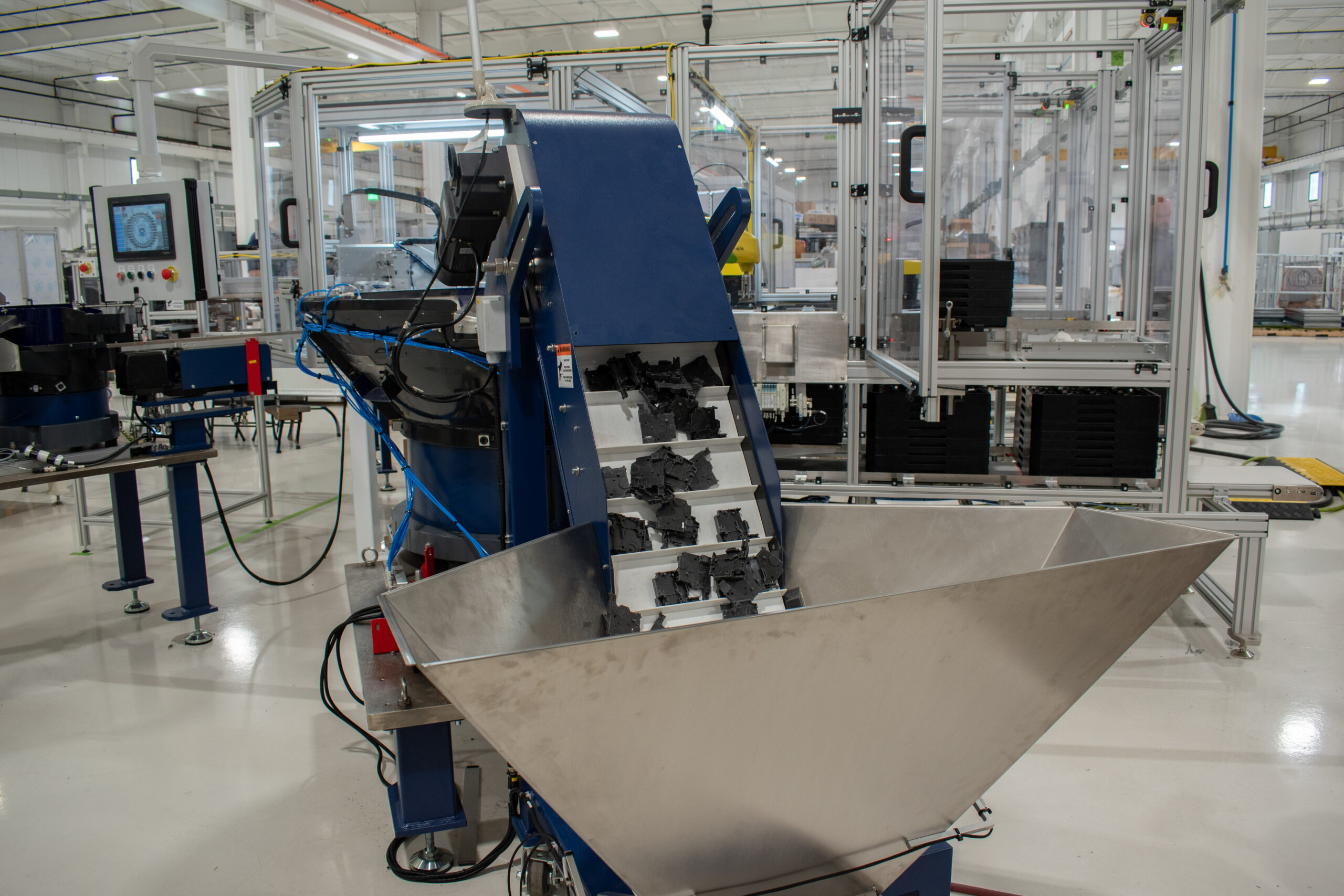
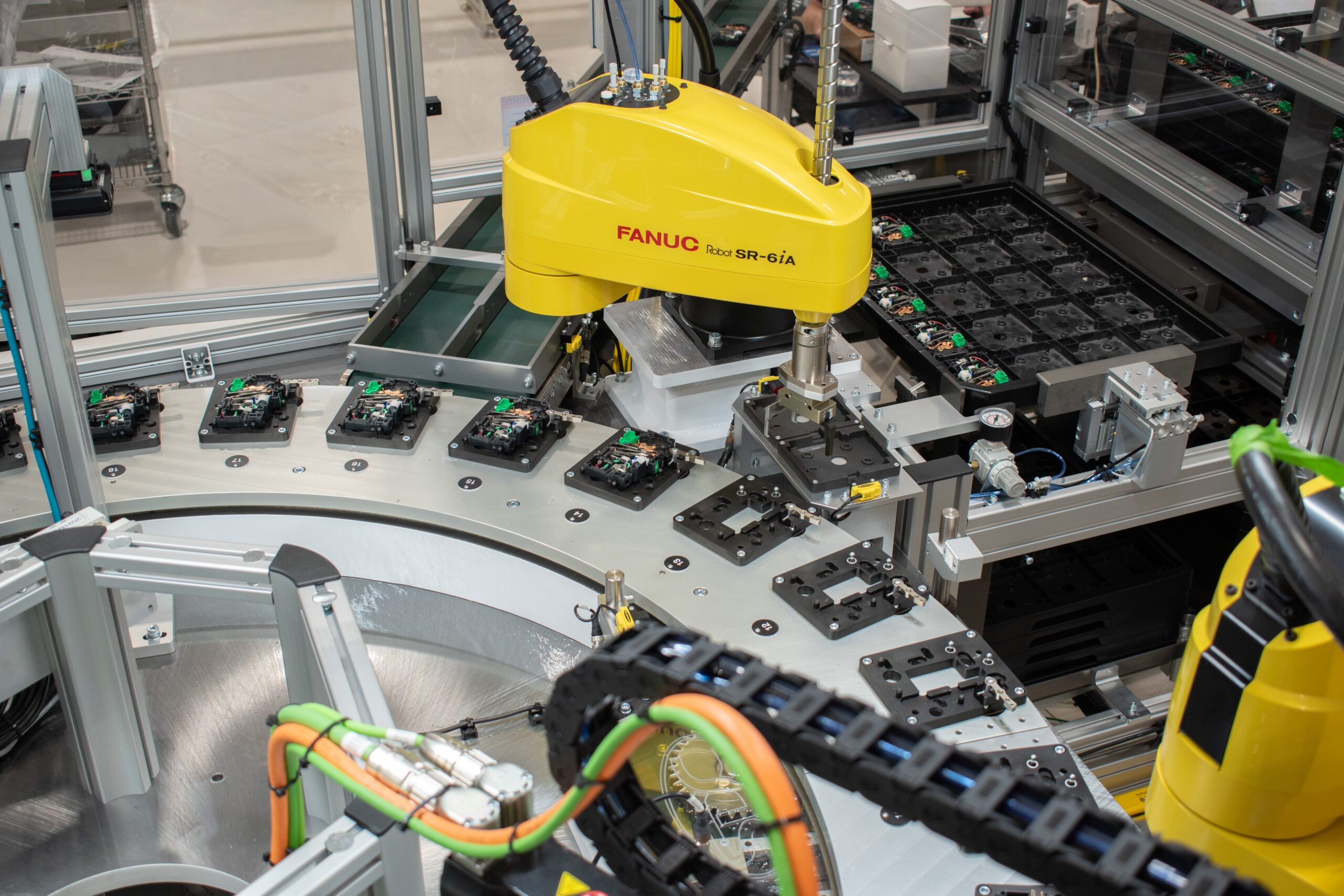
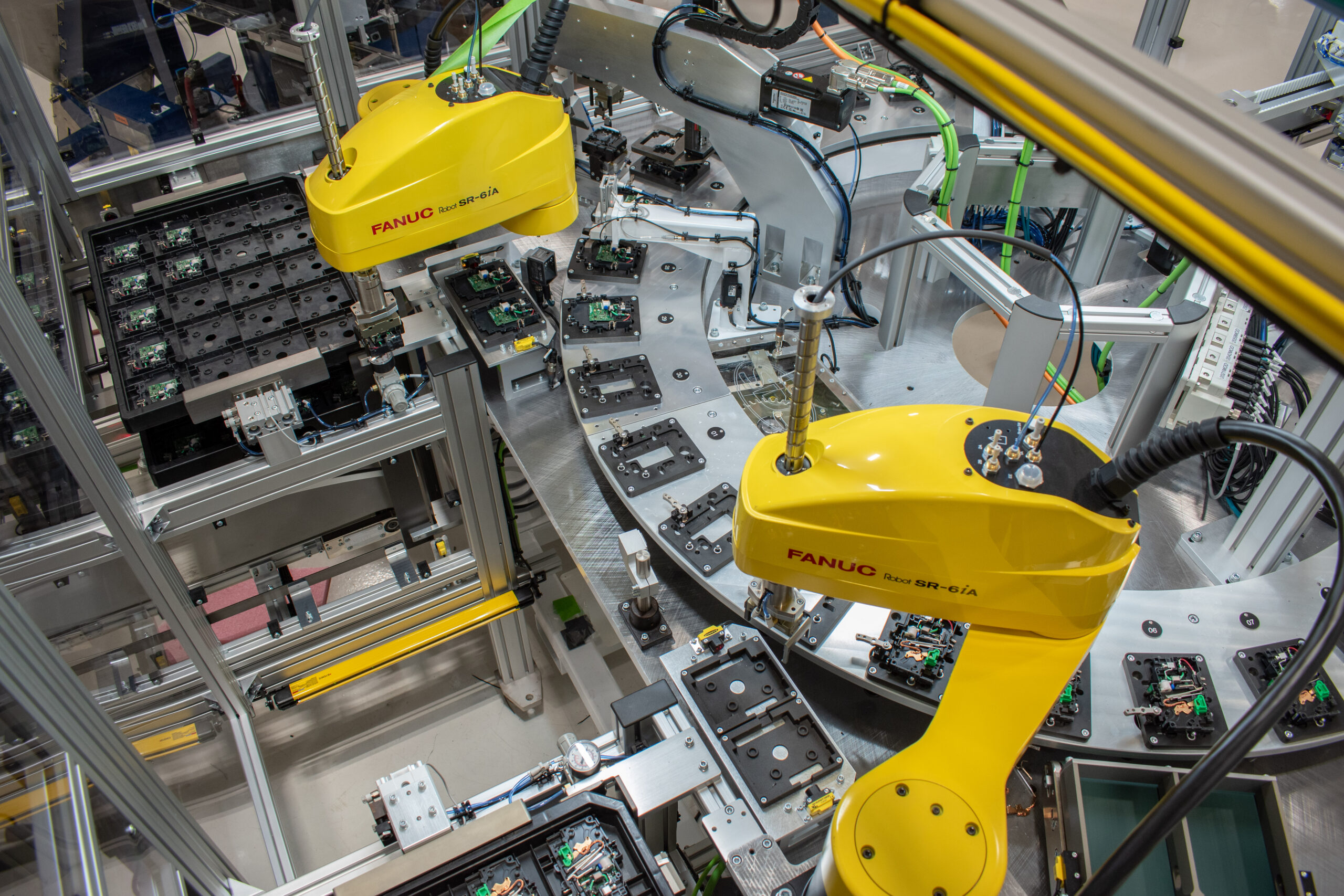
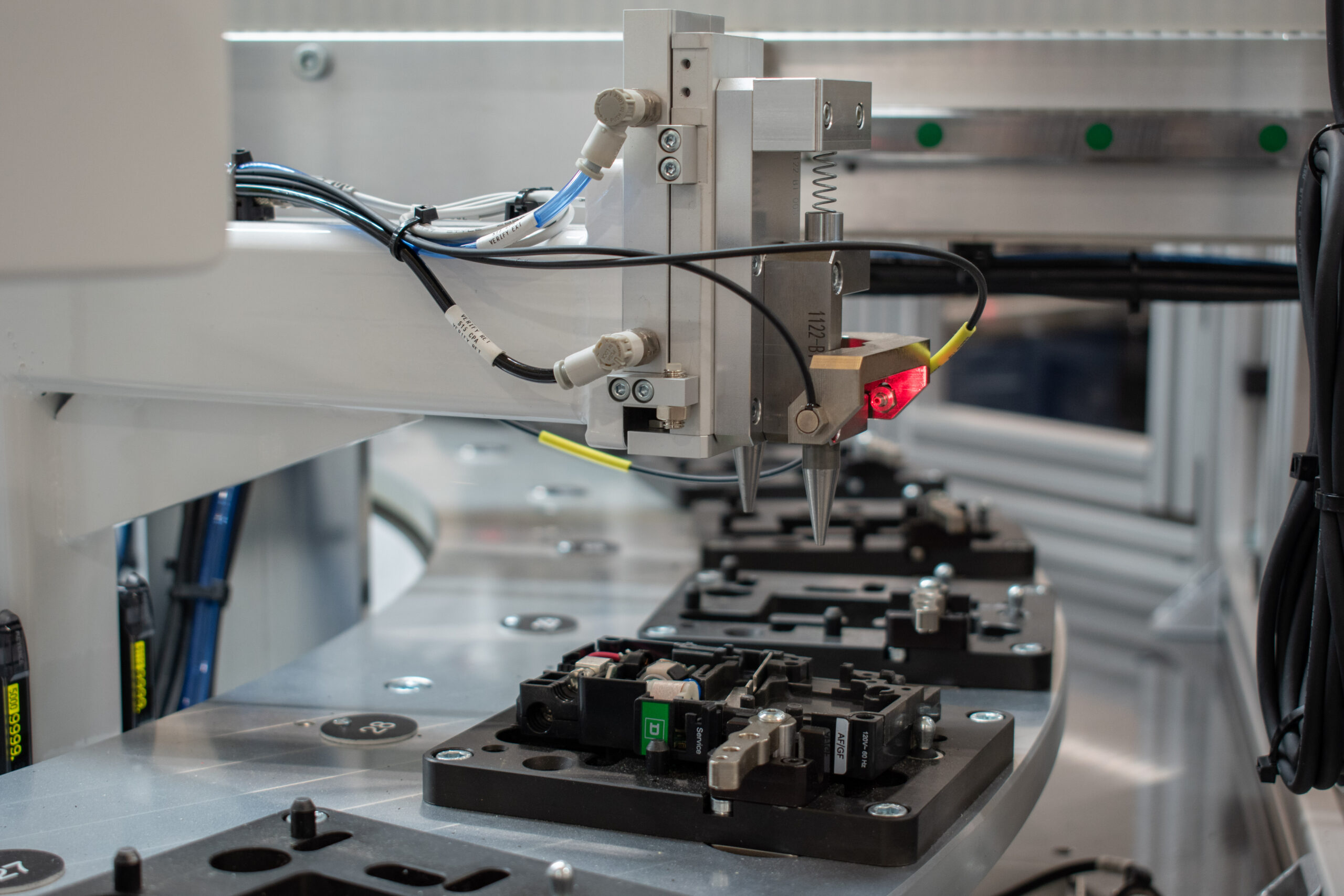
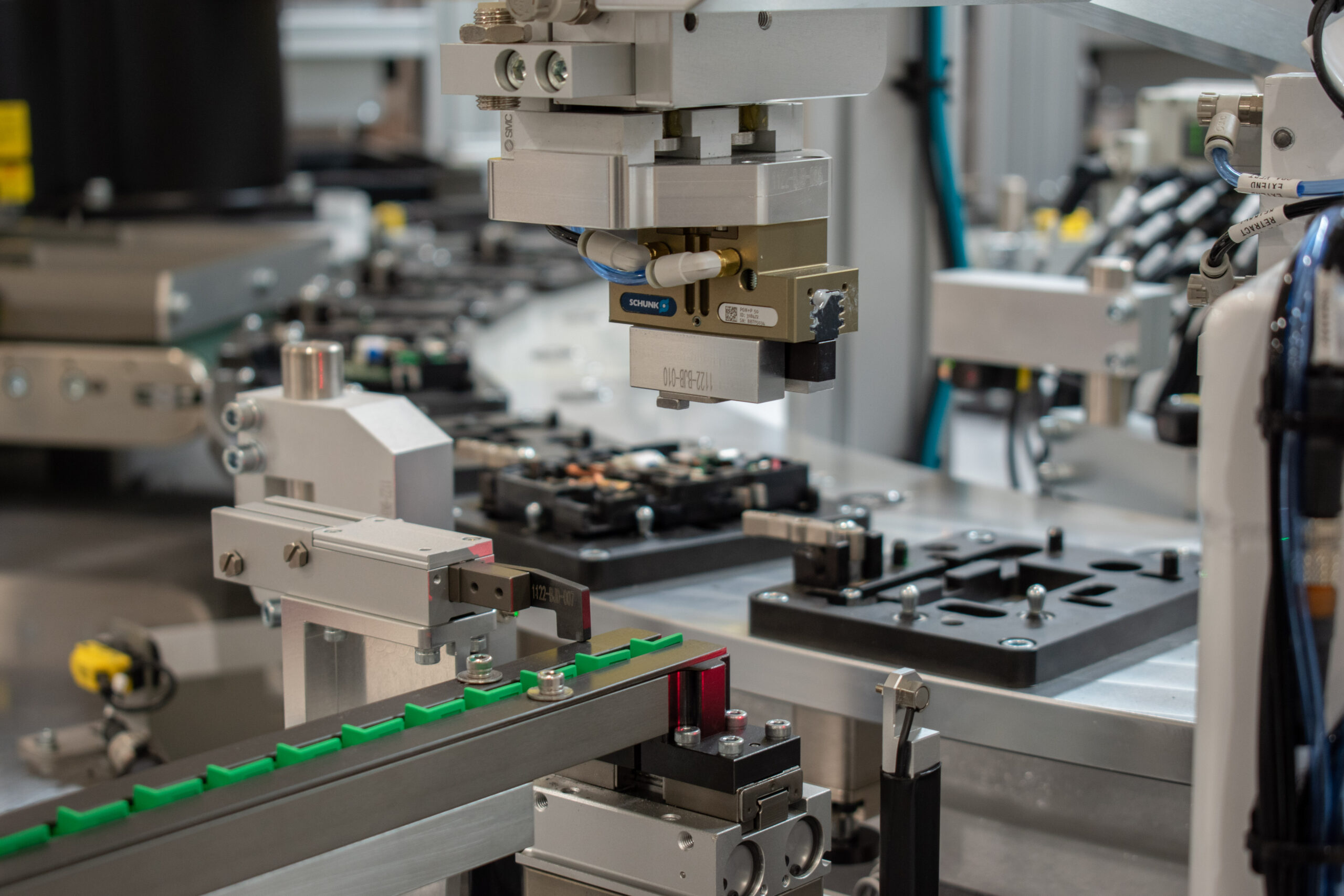
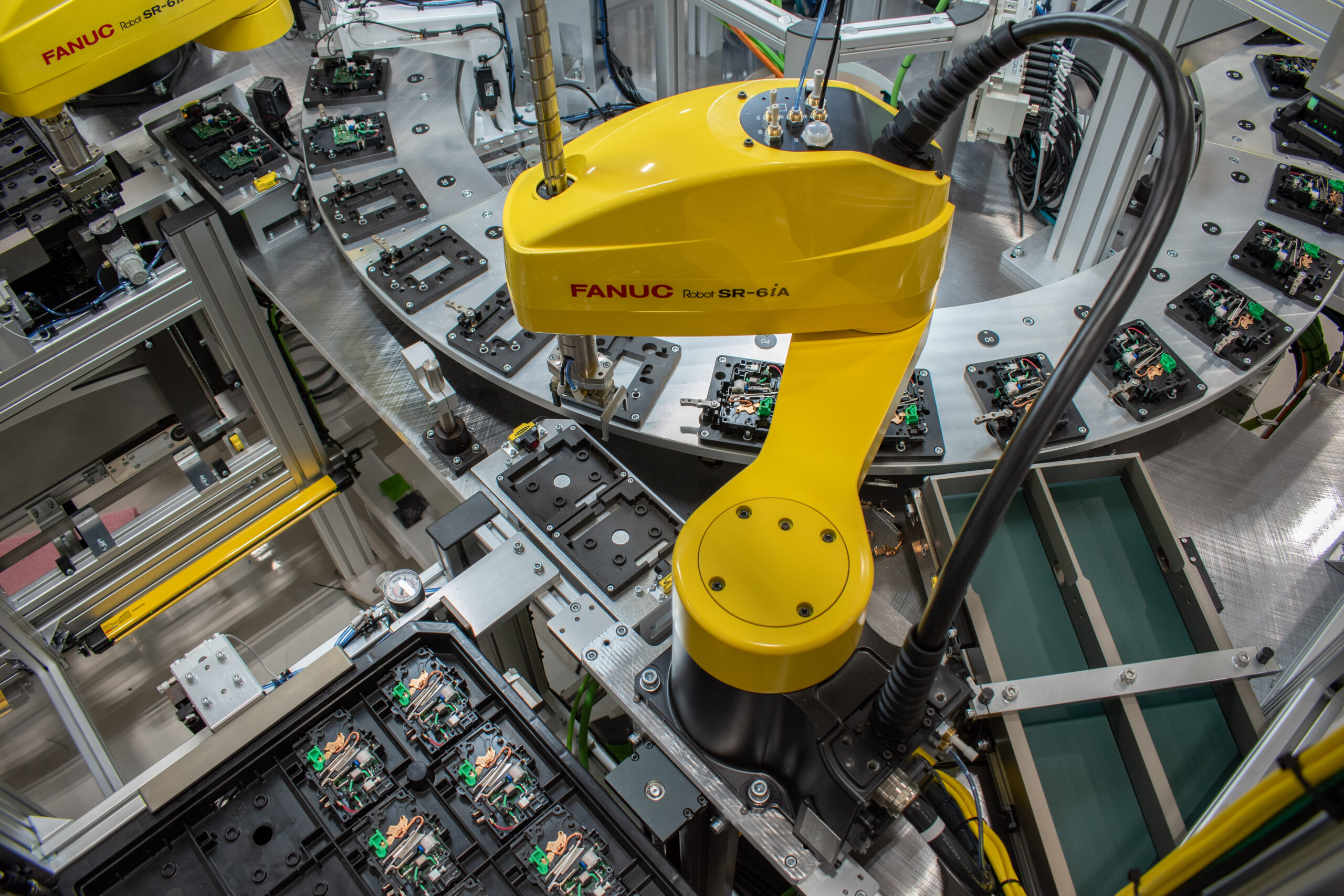
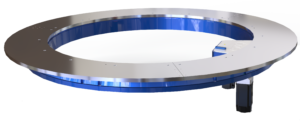
SDC’s concept centered on building the machine around a single servo-driven SDC Indexing Ring, one of SDC’s pre-engineered technology platforms. This ring handled the full main assembly sequence, from base and circuit board loading through final inspection. A dedicated SDC Tray Handler and FANUC SCARA robot brought in the current path assembly (CPA), a pre-made stranded wire assembly produced on separate equipment and delivered in custom trays. A vision system located each CPA in the tray stacker, and a dynamic tooling fixture positioned both ends of the part before it was fed onto the ring at the right point in the cycle.
This approach let SDC apply proven, pre-engineered technology to a project with many unique part-handling challenges. Instead of building an entirely custom system, SDC adapted its existing indexing ring, tray handling, and pick-and-place designs to fit this application. As a result, engineering risk dropped, and the machine reached production faster.
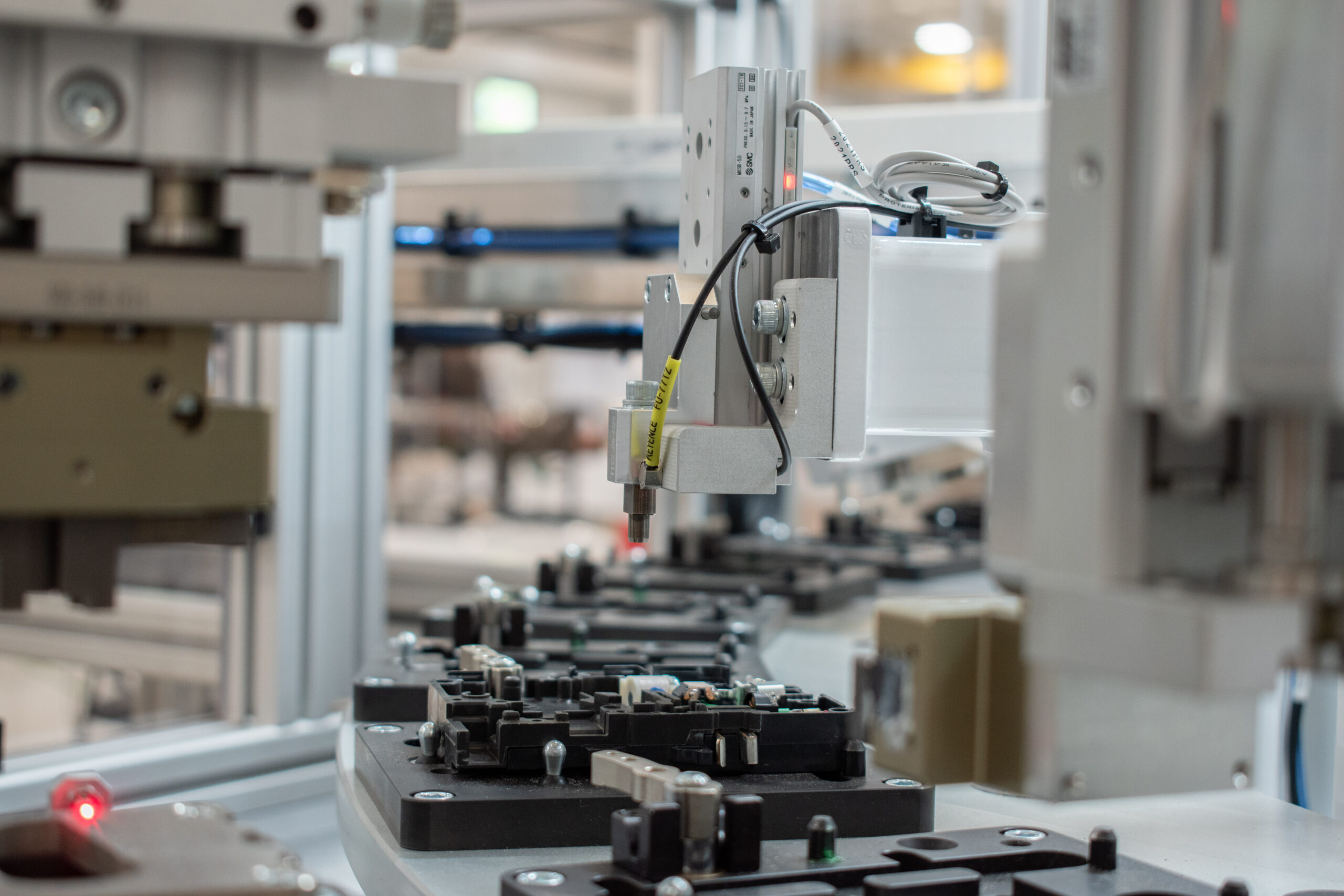
SDC built the machine around a single 30-position servo-driven SDC Indexing Ring, one of SDC’s pre-engineered technology platforms. A FANUC SCARA robot and SDC Tray Handler destacked trays of base and circuit board subassemblies and loaded them into the ring’s fixtures. As the ring indexed forward, SDC pick-and-place units installed a mid base and several more components. Vertical probes after each insertion operation checked that each part was fully seated.
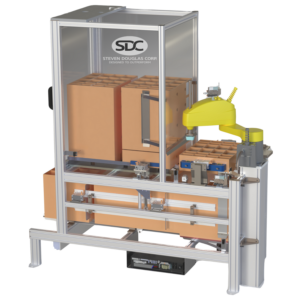
Meanwhile, a second SDC Tray Handler processed 40 custom trays built to work alongside the customer’s own plastic trays of 28 assemblies each. A vision system identified each CPA’s location and orientation in the tray stacker, and a second FANUC SCARA robot, fitted with a multi-gripper end-of-arm tool, picked the assembly and transferred it to a dynamic tooling fixture that positioned both ends of the part.
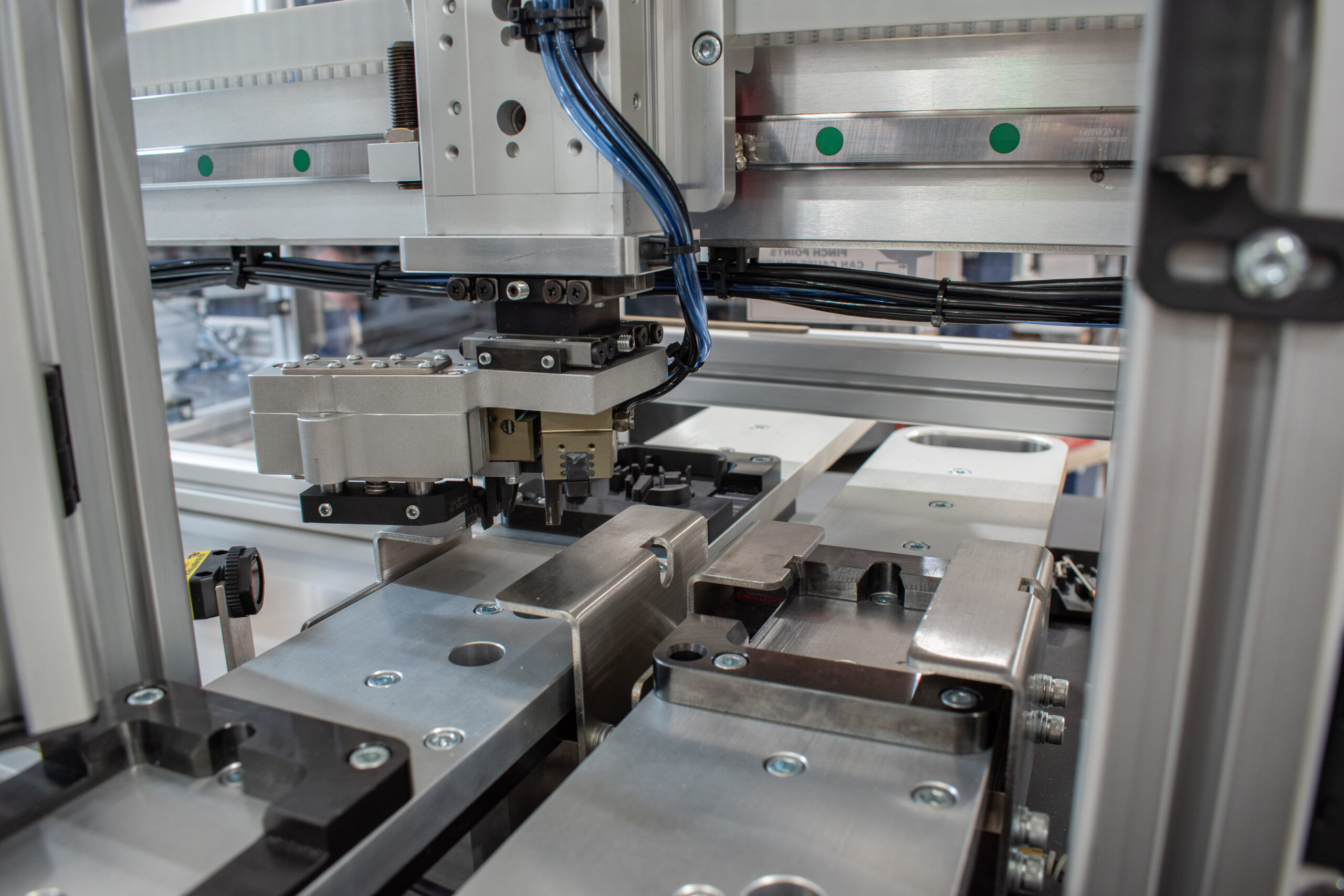
From there, a servo-driven transfer system carried the positioned CPA into the main indexing ring, where an SDC pick-and-place installed it into the base assembly. A vision system inspected the assembly at this point, flagging any part that did not meet requirements before it moved on.
A third FANUC SCARA robot and SDC Tray Handler then unloaded finished assemblies. Good assemblies were placed onto a finished parts tray, while rejected parts were routed to a separate reject station for review.
The finished system was designed to run at a 3-second cycle time, with a target of 2.8 seconds as tooling and programming were optimized. As a result, the customer gained a reliable, repeatable production rate for a part that previously required careful manual assembly.
This project relied on the SDC Indexing Ring, one of SDC’s proven, pre-engineered technology platforms. Its open-ring design lets SDC place workstation modules exactly where the process needed them, giving the main assembly a reliable, repeatable foundation. Because the platform was already engineered and tested, SDC applied it to this project with less risk and a faster path to production.
SDC also used its SDC Tray Handling system to manage part trays throughout the process. This pre-engineered platform automated tray loading and unloading at three points in the machine, cutting down on manual material handling. As a result, operators could focus on other tasks instead of restocking trays by hand.
Overall, this project shows how SDC applies proven, pre-engineered technology to solve complex assembly challenges. By combining the SDC Indexing Ring, SDC Tray Handling, robotics, and vision inspection, SDC gave this manufacturer a reliable, high-speed way to assemble a multi-part product. The design addressed the customer’s need for consistent quality without relying on manual assembly. It also built in the flexibility to run more than one product variation on the same machine. This kind of ring-based architecture is a strong example of how SDC’s standard technology can be adapted to fit unique customer requirements. In the end, the result is a machine that reduces engineering risk while still meeting each customer’s specific production needs.
A: A circuit breaker assembly machine is automated equipment that builds a circuit breaker’s internal parts into one finished unit. These parts include the base, housing, armature, blade holder, and current path assembly. The machine replaces manual assembly steps with robots, feeders, and automated inspection.
A: The machine was designed for a 3-second cycle time, with a target of 2.8 seconds per part once fully optimized. That means it can complete one finished assembly roughly every 3 seconds.
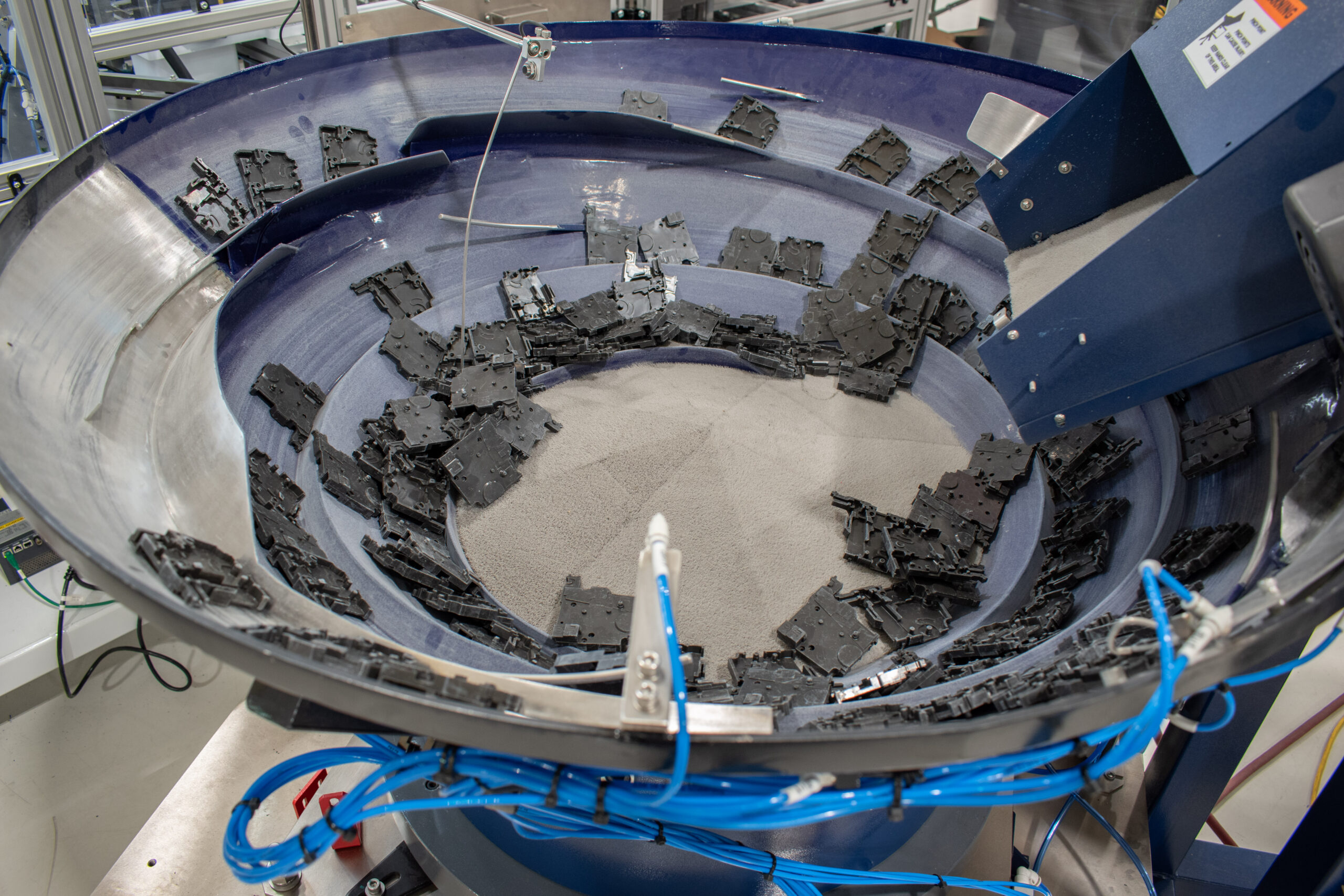
A: SDC used the SDC Indexing Ring, a pre-engineered technology platform, to run the main assembly. It also added SDC pick-and-place units, three FANUC SCARA robots, and three SDC Tray Handlers. Two Bellco vibratory bowl feeders, a preforming station, and vision inspection systems rounded out the technology, helping load, orient, and assemble the parts.
A: The machine uses vision inspection systems at multiple stages of the process. Each assembly is checked before moving to the next step, so problems are caught early and rejected parts are automatically routed away from good ones.
A: Yes. The machine was designed to run more than one product variation with minimal changeover, so the customer can switch between parts without major downtime.