
Custom automation machines are increasingly becoming the foundation of modern industrial automation systems across nearly every industry but especially electrical, automotive, medical device, and consumer manufacturing sectors. If you’re evaluating custom automation, you’re probably feeling pressure somewhere in your operation.
- Labor is tight.
- Throughput needs to increase.
- Quality expectations aren’t forgiving.
- And manual processes are starting to show their limits.
Before you request a quote or approve a capital budget, it’s important to understand what custom automation really involves — financially, technically, and strategically.
This guide breaks down how custom automation machines work, what they cost, how ROI is calculated, where AI in manufacturing fits, and how to evaluate the right automation machine builder.
Jump to:
- What Is a Custom Automation Machine?
- How Much Do Custom Automation Machines and Automated Assembly Systems Cost?
- The Custom Automation Development Process: Why Structure Determines Success.
- Industrial Robotics Integration vs Fixed Automation: What’s Right?
- AI in Custom Automation Machines: Where It Actually Adds Value.
- Preparing Your Organization for Custom Automation Success.
- Final Thoughts.
- Frequently Asked Questions About Custom Automation Machines.
What Is a Custom Automation Machine?
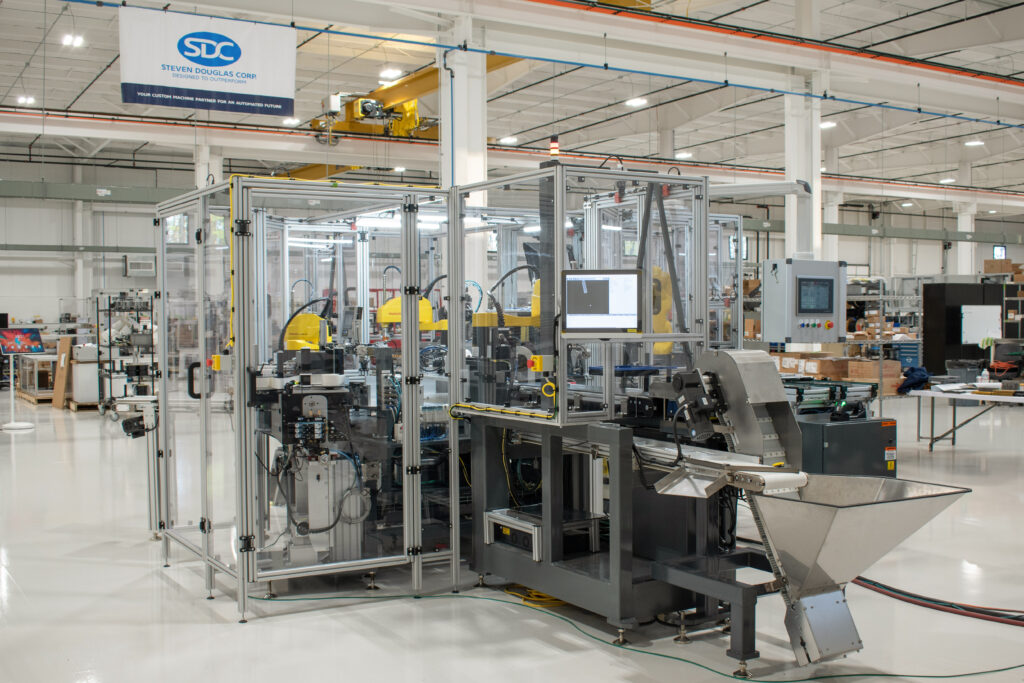
A custom automation machine is a purpose-built industrial automation system engineered around a specific manufacturing process, product geometry, and production target — not a generalized application.
Unlike standard industrial automation systems, which are pre-designed for broad use cases and configured to fit “most” scenarios, custom automation machines are designed from the ground up to meet exact cycle times, tolerance requirements, quality standards, and integration constraints.
Standard equipment can be effective for stable, common processes, but it often struggles when product variability, throughput demands, or precision requirements increase.
Custom automation systems, by contrast, are built to handle real-world manufacturing conditions — part inconsistencies, high-volume output, robotics integration, AI-powered inspection, and future scalability — making them a strategic solution rather than a temporary fix.
Custom automation systems are designed around:
- Your exact product geometry
- Your required cycle time
- Your production volume
- Your facility constraints
- Your data and integration needs
Custom machines often include:
- Custom machine stations and components
- Robotic integration cells
- AI-powered inspection systems
- Industrial vision systems
- Integrated test and validation stations
- Complete production lines
In modern manufacturing automation solutions, these systems frequently combine industrial robotics integration, controls architecture, machine vision, and smart factory data infrastructure.
Custom Automation Machines vs Standard Industrial Automation Systems
Standard industrial automation systems are pre-designed for common applications.
Custom automation machines are engineered for:
- Unique tolerances
- Complex product families
- High-volume output
- Tight quality control
- Long-term scalability
Off-the-shelf solutions can be effective — until variability, growth, or quality constraints expose their limitations. That’s where a true custom automation system becomes strategic.
When Does It Make Financial Sense to Invest in Custom Automation Machines?
Custom automation isn’t about replacing people. It’s about stabilizing output and scaling intelligently.
The most common drivers behind custom assembly machines and industrial automation systems include:
- Labor shortages or turnover
- Inconsistent manual quality
- Safety risk exposure
- Cycle time bottlenecks
- Capacity limitations
- High scrap or rework rates
A Practical ROI Framework for Custom Automation Systems
Successful automation investments are grounded in measurable financial impact.
1. Labor Exposure
Labor is often the most visible and immediate driver of ROI in a custom automation project. For example, three operators earning a fully loaded cost of $60,000 per year across two shifts represents $360,000 in annual labor exposure. Even reducing one operator per shift can significantly shift payback timelines. Beyond direct headcount reduction, automation also stabilizes labor volatility — reducing overtime, turnover impact, and training variability — which strengthens the financial case over time.
2. Throughput Gains
Throughput improvement is frequently an even stronger ROI driver than labor reduction. If a manual process runs at 20 seconds per unit and a custom automation machine reduces that cycle time to 12 seconds, that represents a 40% increase in output capacity. In high-volume manufacturing environments, this acceleration can eliminate bottlenecks, reduce overtime, increase available capacity, or delay the need for additional capital investment. In many cases, throughput gains alone justify the investment.
3. Scrap & Rework Reduction
Quality improvement compounds quickly in precision-driven industries. AI-powered inspection systems and well-engineered custom assembly machines often reduce defect rates from 4–5% to under 1%. In automotive, medical device, electronics, and electrical manufacturing environments, that reduction translates directly into material savings, reduced rework labor, and improved customer confidence. Scrap reduction not only improves margins — it stabilizes production consistency.
4. Payback Expectations
Typical ROI timelines vary based on complexity and application. Semi-automated cells may see payback within approximately 16–24+ weeks. Multi-station custom automation machines often fall within the 20–40+ week range. Fully integrated industrial automation systems can range from 24–52+ weeks depending on scope and performance targets. However, ROI is influenced by production volume, process stability, implementation quality, and long-term scalability planning. Longer payback periods may still make strategic sense when automation is driven by growth, risk mitigation, or competitive positioning — not just immediate labor savings.
How Much Do Custom Automation Machines and Automated Assembly Systems Cost?
It’s the most common question we hear. And the most honest answer is: it depends on complexity — and on who is building it.
Custom automation machines are engineered systems, not catalog products. The cost of a custom automation system reflects the depth of engineering required to make it reliable, scalable, and capable of running in real-world manufacturing conditions.
What Impacts the Cost of Custom Automation Systems?
Several factors drive investment level:
- Complexity of parts
- Quantity and variation of product families
- Number of stations
- Industrial robotics integration
- AI in manufacturing features (inspection, predictive maintenance)
- Vision system sophistication
- Controls architecture
- Data integration with MES or ERP systems
- Safety compliance requirements
- Tolerance precision
- Future scalability requirements
And the list can go on. The key point: automation cost is driven far more by engineering depth than by visible hardware.
Typical Budget Ranges
While every project is unique, realistic investment ranges look like this:
- Semi-automated station: $150,000 – $350,000+
- Single-station for focused assembly systems: $200,000 – $600,000+
- Multi-station custom assembly machine: $5000,000 – $1.5 million+
- Fully integrated industrial automation system: $1M – $5 million+
These ranges reflect properly engineered systems — not stripped-down builds designed to win on price alone.
Why Two “Similar” Machines Can Vary 2–3x in Price
Two automation systems may look nearly identical on the surface and still vary significantly in cost. The difference usually comes down to:
- Engineering depth
- Controls quality and architecture
- Expandability
- Durability of components
- Safety system design
- AI-powered inspection capability
- Long-term service and support structure
This is exactly why partnering with a competent automation machine builder matters so much.
A strong machine builder doesn’t just design a machine to run during Factory Acceptance Testing. They design it to:
- Run reliably under production stress
- Handle part variability
- Scale with volume increases
- Integrate into broader smart factory systems
- Support AI in manufacturing where it adds measurable value
Inexperienced or under-resourced builders may offer a lower upfront number — but often at the expense of controls robustness, future flexibility, or long-term reliability.
And in custom automation, reliability is everything. Automation built cheaply rarely stays cheap.
Sometimes the Best Reason to Automate Is Peace of Mind
Not every automation decision starts with a spreadsheet. Sometimes it starts with a 2:00 a.m. phone call.
One operator calls off. Another is late. A key assembler quits mid-shift. Quality drifts because a new hire hasn’t quite developed the feel for the process yet. None of this is unusual — it’s the reality of managing a human workforce in modern manufacturing.
A well-designed custom automation machine doesn’t eliminate people from your operation. But it does remove volatility from critical processes.
Custom automation systems are built to:
- Run the same cycle the same way every time
- Maintain consistent torque, force, and placement
- Execute inspection logic without fatigue
- Deliver predictable throughput shift after shift
Humans are adaptable and valuable — especially in problem-solving and oversight. But repetitive, precision-driven assembly or inspection tasks are where inconsistency creeps in. Fatigue, distraction, turnover, and training gaps all introduce variability.
A properly engineered industrial automation system doesn’t call off. It doesn’t speed up or slow down based on experience level. It doesn’t drift in quality because of shift changes.
For many manufacturers, the greatest ROI isn’t just labor reduction or throughput improvement.
It’s stability. It’s knowing that your most critical process will perform tomorrow exactly the way it performed today.
In high-volume or high-consequence manufacturing environments — electrical devices, automotive, medical device, aerospace — that peace of mind isn’t a luxury.
It’s risk management. When evaluating custom automation machines, don’t underestimate the strategic value of reliability. Because sometimes the most powerful return on investment is the one you don’t see — the problems that never happen.
The Custom Automation Development Process: Why Structure Determines Success
Custom automation machines succeed or fail long before they ship. Not because of hardware. Because of process.
A rigid, disciplined project management structure is one of the biggest predictors of whether an industrial automation system will meet throughput targets, pass acceptance criteria, and perform reliably years down the road.
At SDC, our automation development process is built around four clearly defined phases. Each phase exists to reduce risk, control scope, and protect the final result.
01 — DESIGN & ENGINEER
Every successful custom automation system starts with disciplined engineering.
Our mechanical and electrical controls engineering teams work directly with clients to ensure each system is designed to meet every specification and requirement — not just in theory, but in production reality.
This phase includes:
- Process evaluation and requirement validation
- Cycle time confirmation
- Part variability analysis
- Mechanical system design
- Controls architecture development
- Industrial robotics integration (when required)
- AI-powered inspection design (where applicable)
- Safety system engineering
- Data integration planning for MES, ERP, and smart factory systems
This is where 80% of project success is determined.
A structured engineering phase prevents:
- Scope creep
- Undefined expectations
- Late-stage redesign
- Budget overruns
Without rigid project controls here, even the best machine builders are reacting instead of engineering.
02 — BUILD
Once engineered properly, the system moves into in-house build.
Our machine builders and electricians assemble each custom automation machine internally, working closely with engineering to ensure the physical build matches the intended design.
This controlled build phase allows:
- Immediate issue resolution
- Tight feedback loops between engineering and production
- Quality control over every mechanical and electrical component
- Validation of industrial automation system integration
When build is fragmented or loosely managed, small inconsistencies compound into larger reliability issues later.
In-house coordination reduces that risk.
03 — TEST & RUN-OFF
Testing is not a formality. It is validation.
Each SDC system undergoes rigorous machine testing — often referred to as run-off or Factory Acceptance Testing (FAT) — to ensure it passes defined client acceptance criteria before leaving our facility.
This includes:
- Cycle time validation
- Throughput verification
- AI-powered inspection accuracy checks
- Industrial robotics integration validation
- Safety compliance testing
- Data reporting confirmation
- Repeatability testing under production conditions
A disciplined run-off process protects both the client and the automation machine builder.
Machines that are rushed out the door without structured validation almost always surface problems on the production floor — where downtime is far more expensive.
04 — SUPPORT
Automation does not end at installation. Custom automation systems are long-term assets, and they require long-term partnership.
For as long as the machine is in production, we provide:
- Technical troubleshooting
- Controls support
- Performance optimization
- Expansion planning
- Integration updates for evolving smart factory initiatives
This final phase reinforces why disciplined project management matters from day one.
When documentation is structured, engineering is thorough, and controls architecture is robust, post-install support becomes proactive rather than reactive.
Why a Rigid Project Management Process Matters
In custom automation, complexity compounds quickly:
- Mechanical systems interact with controls
- Robotics interacts with vision
- AI interacts with data infrastructure
- Safety systems overlay everything
Without a structured, phase-gated project management approach, risk multiplies.
A rigid process ensures:
- Requirements are defined before engineering begins
- Engineering is complete before build starts
- Build is validated before shipment
- Acceptance criteria are measurable
- Accountability exists at every stage
This is especially critical when integrating advanced capabilities like industrial robotics integration or AI in manufacturing. These technologies add power — but also add complexity.
Structure protects performance. In the end, the quality of a custom automation machine is rarely determined by the components alone. It’s determined by the discipline of the process used to design, build, test, and support it.
And that discipline is what separates automation that simply runs… from automation that runs reliably for years.
Timeline Expectations for Custom Automation Projects
Custom automation projects require realistic planning timelines based on scope and complexity.
- Simple systems: 16-20+ weeks
- Mid-complexity machines: 20-36+ weeks
- Complex multi-station lines: 36-50+ weeks
These timelines account for disciplined engineering, in-house build, rigorous testing, and structured commissioning. Attempting to compress these phases — particularly the design and engineering stage — often leads to scope gaps, change orders, performance issues, and higher downstream costs. In custom automation, time invested upfront in structured planning and validation protects schedule, budget, and long-term system reliability.
Why Custom Automation Projects Fail (And How to Avoid It)
Most custom automation projects don’t fail because the technology doesn’t work. They fail because key fundamentals were missed early in the process. Here are the most common failure points — and how to prevent them.
1️⃣ Poorly Defined Requirements
If there isn’t clear internal alignment before engineering begins, the automation machine builder is forced to make assumptions.
Misalignment often happens around:
- Throughput targets
- Quality metrics
- Product mix and SKU variation
- Future expansion plans
- Shift structure and labor model
When expectations aren’t clearly defined, scope gaps emerge. Those gaps lead to change orders, redesigns, timeline delays, and budget increases.
How to avoid it:
Define measurable performance criteria before requesting proposals. The clearer your expectations, the more predictable the outcome.
2️⃣ Underestimating Real-World Variability
Manufacturing environments are not perfect.
Parts vary. Materials fluctuate. Operators handle components differently. Environmental conditions change.
Custom automation systems must account for:
- Tolerance stack-ups
- Material inconsistency
- Temperature and humidity shifts
- Wear over time
- Handling variation upstream
When systems are engineered only for “ideal” conditions, performance degrades once production starts.
How to avoid it:
Work with an automation partner who pressure-tests the process under real-world conditions — not just theoretical ones.
3️⃣ Choosing Based on Lowest Price
Industrial automation systems are not commodities.
Two custom automation machines may look similar on paper but differ significantly in:
- Engineering depth
- Controls architecture
- Scalability
- Safety design
- Documentation quality
- Long-term support
Lowest upfront cost often results in:
- Increased downtime
- Limited scalability
- Expensive retrofits
- Performance instability
In custom automation, the cheapest proposal frequently becomes the most expensive over time.
How to avoid it:
Evaluate proposals based on engineering scope and long-term reliability — not just capital expense.
4️⃣ Lack of Internal Ownership
Even the best industrial automation system requires internal accountability after installation.
Common issues include:
- No clear performance owner
- Reactive maintenance instead of preventive
- No data review cadence
- Limited continuous improvement efforts
Without defined operational ownership, performance drifts and ROI declines.
How to avoid it:
Before installation, determine who owns:
- Performance monitoring
- Preventive maintenance
- Optimization initiatives
- Ongoing system evaluation
The Bottom Line
Successful custom automation projects combine:
- Clear requirements
- Realistic process validation
- Strong engineering
- Disciplined project management
- Defined internal ownership
Technology alone doesn’t guarantee results.
Structure, clarity, and accountability do.
Industrial Robotics Integration vs Fixed Automation: What’s Right?
Industrial robotics integration is powerful — but it isn’t automatically the right answer for every manufacturing challenge.
There’s a tendency in the market to assume that “robotic” equals “advanced.” In reality, the best solution depends on your volume, variability, cycle time, and long-term production goals.
Custom automation machines can incorporate robotics, fixed (hard) automation, or a hybrid of both. The right approach isn’t about trends — it’s about performance.
When Industrial Robotics Integration Makes Sense
Robotics shine in environments that demand flexibility.
Industrial robotics integration is often the right choice when you have:
- High-mix, low-volume production
If your product families change frequently, robots allow reprogramming rather than retooling. - Frequent changeovers
Robots can adapt to new SKUs with updated programming instead of mechanical redesign. - Complex handling or motion paths
Multi-axis movement, angled placements, or intricate pick-and-place operations are ideal for robotic systems. - Collaborative applications
In some workflows, robots work alongside operators, increasing safety and reducing repetitive strain. - Future uncertainty
If product geometry or process flow is likely to evolve, robotics provide adaptability.
In these cases, robotics offer long-term flexibility that fixed automation cannot.
However, flexibility comes with trade-offs — particularly in speed and cost.
When Dedicated Custom Assembly Machines Win
Fixed automation — often called hard automation — is purpose-built for one job.
And when that job doesn’t change, it often outperforms robotics in measurable ways.
Dedicated custom assembly machines are typically superior when you need:
- High-volume output
If you’re running millions of parts per year, fixed automation is often faster and more cost-efficient. - Tight cycle times
Mechanical cam-driven systems and purpose-built mechanisms frequently outperform robotic arms in raw speed. - Highly repeatable processes
When the product doesn’t vary, fixed automation reduces complexity and maximizes uptime. - Lower long-term maintenance costs
Simpler motion systems can be easier to maintain in stable environments.
In high-throughput environments — automotive, consumer products, medical disposables — fixed automation often delivers better ROI than robotics alone.
Cost, Speed, and Complexity Trade-Offs
Robotics offer flexibility but may:
- Require more advanced programming
- Can introduce additional failure points
- Can increase integration complexity
- Add capital cost
Fixed automation offers speed and simplicity but may:
- Be less adaptable to product changes
- Require mechanical modification for new SKUs
- Be optimized for narrower applications
This is why automation decisions should be grounded in long-term production strategy — not just current needs.
The Hybrid Approach: Where Most Advanced Systems Land
In modern manufacturing automation solutions, the best systems often combine both approaches.
For example:
- Robotics for material handling
- Fixed automation for precision assembly
- AI-powered inspection for quality validation
- Integrated controls architecture tying it all together
This hybrid model allows manufacturers to capture the flexibility of robotics while maintaining the speed and reliability of dedicated automation.
When combined properly, industrial robotics integration and custom assembly machines complement each other rather than compete.
The Real Question to Ask
Instead of asking your machine builder: “Should we use robotics?” The better question is: “What architecture gives us the best combination of throughput, flexibility, reliability, and ROI?”
That answer varies by facility, product, and growth strategy. The goal isn’t to install robotics for the sake of saying you have robotics.
The goal is to build a custom automation system that performs — today and five years from now. That’s why selecting the right automation machine builder matters so much.
A strong partner won’t default to robotics because it sounds advanced, and they won’t default to fixed automation because it’s simpler to engineer. They’ll challenge assumptions, pressure-test your throughput goals, evaluate product variability, and recommend the architecture that actually fits your manufacturing environment.
When evaluating a partner, ask them to justify their decision:
- Why robotics here instead of dedicated automation?
- What happens if volumes double?
- How will this system handle product variation?
- What are the long-term maintenance implications?
- Is this the most efficient architecture — or just the most familiar one?
The right automation partner should be willing to debate the solution with you. Because the best machine isn’t the most complex one — it’s the one engineered specifically for how your operation runs.
AI in Custom Automation Machines: Where It Actually Adds Value
There’s a lot of noise around AI in manufacturing. Some of it is useful. Some of it is marketing.
In real-world custom automation machines, AI is not a replacement for engineering. It’s an enhancement layer — one that sits on top of strong mechanical design, disciplined controls architecture, and well-built industrial automation systems.
Modern manufacturing automation solutions often combine:
- Custom assembly machines
- Industrial robotics integration
- Vision systems
- Structured data collection
- AI-powered analytics
But AI only delivers value when it’s applied intentionally.
AI-Powered Inspection: When Rules Aren’t Enough
Traditional vision systems rely on rule-based logic — defined thresholds, contrast levels, edge detection parameters.
That works well when conditions are stable.
But AI-powered inspection systems outperform rule-based systems when:
- Defects are subtle or irregular
- Product appearance varies slightly
- Lighting conditions shift
- Surface textures are inconsistent
In high-mix or visually complex environments, machine learning models can reduce false rejects and improve defect detection consistency.
The key is proper training data and disciplined implementation. AI inspection layered onto a poorly engineered system won’t fix underlying mechanical instability.
Predictive Maintenance: Reducing Unplanned Downtime
In advanced industrial automation systems, AI can analyze:
- Vibration signatures
- Motor loads
- Temperature trends
- Cycle time anomalies
Instead of reacting to failure, predictive models identify patterns that indicate wear or drift before they become downtime events.
For manufacturers running high-volume custom automation machines, preventing a single unplanned shutdown can justify the investment.
But again, this only works if the system was designed from the beginning to capture clean, usable data.
Intelligent Process Optimization
AI also plays a role in performance refinement.
Modern smart factory systems leverage machine learning to:
- Identify micro-stoppages
- Detect efficiency drift
- Surface bottleneck trends
- Optimize cycle performance over time
This is where AI in manufacturing shifts from novelty to operational advantage — when it helps teams make better decisions based on real production data.
Where AI Is Overkill
Not every process needs artificial intelligence.
Stable, highly repeatable operations with minimal variability often perform better with deterministic PLC logic and well-engineered controls.
Adding AI where it isn’t needed introduces unnecessary complexity, higher integration cost, and more maintenance variables.
AI should enhance automation — not complicate it.
A competent automation machine builder should be willing to tell you when AI is unnecessary.
Preparing Your Organization for Custom Automation Success
Technology alone doesn’t guarantee results. Before investing in custom automation machines — especially those incorporating AI in manufacturing — manufacturers should evaluate organizational readiness.
Ask internally:
- Is leadership aligned on throughput and ROI goals?
- Is engineering engaged early in the process?
- Is maintenance trained and prepared for the new system?
- Does IT infrastructure support Industry 4.0 automation and data integration?
- Is post-install ownership clearly defined?
Automation is not just equipment installation. It’s operational transformation. Without alignment, even the most advanced industrial automation systems will struggle to deliver expected performance.
What Successful Custom Automation Actually Looks Like
Across industries, successful custom automation systems share common characteristics:
- Clear baseline metrics before engineering begins
- Defined throughput and quality targets
- Strong collaboration between manufacturer and automation partner
- Structured, phase-gated project management
- Long-term performance monitoring
When those fundamentals are in place, the results follow:
- Stable output
- Predictable quality
- Reduced labor volatility
- Improved safety
- Scalable smart factory growth
AI, robotics, and advanced controls are powerful tools. But they only deliver results when layered onto disciplined engineering, structured execution, and a partnership focused on long-term performance — not short-term features.
That’s what separates automation that looks advanced from automation that actually performs.
Final Thoughts
Custom automation machines are not simply equipment purchases — they are long-term investments in production stability, quality consistency, and scalable growth.
The most effective industrial automation systems are engineered around real manufacturing conditions: part variability, throughput demands, labor volatility, and long-term expansion plans.
While modern solutions increasingly incorporate industrial robotics integration, AI-powered inspection, and smart factory data infrastructure, those technologies only deliver value when applied with discipline and purpose.
The true difference between automation that performs reliably and automation that creates ongoing frustration comes down to engineering depth, structured project management, and choosing the right automation machine builder — one willing to challenge assumptions and design for your specific environment.
Manufacturing isn’t theoretical. It’s measurable, operational, and demanding. Your custom automation system should be built the same way.
Frequently Asked Questions About Custom Automation Machines
What is a custom automation machine?
A custom automation machine is a purpose-built industrial automation system engineered specifically around a manufacturer’s product, process, cycle time, and long-term production goals.
Unlike standard equipment designed for broad applications, custom automation machines are developed to handle real-world manufacturing conditions — including part variability, high-volume output, robotics integration, AI-powered inspection, and future scalability.
How much do custom automation machines cost?
Custom automation machines typically range from $150,000 for semi-automated stations to $5M+ for fully integrated industrial automation systems.
The final cost depends on engineering complexity, number of stations, robotics integration, AI features, safety requirements, and long-term scalability.
Two similar-looking systems may vary significantly in price based on engineering depth, controls architecture, and support structure — which is why selecting the right automation machine builder is critical.
How long does it take to design and build a custom automation system?
Project timelines typically range from 20-36 weeks depending on scope and complexity. Small automation cells may take 16-20 weeks, while multi-station systems or full production lines can take 36-50+ weeks.
A structured, phase-gated project management process — including design, build, run-off testing, and long-term support — is essential to keeping projects on schedule and preventing costly downstream issues.
Should we use industrial robotics or fixed automation?
The right solution depends on your manufacturing environment. Industrial robotics integration makes sense for high-mix, low-volume production or flexible changeovers.
Dedicated custom assembly machines often outperform robotics in high-volume, tight-cycle applications.
The best automation machine builders evaluate throughput goals, product variability, and long-term growth plans before recommending robotics, fixed automation, or a hybrid approach.
Where does AI fit into custom automation machines?
AI in manufacturing delivers the most value in inspection, predictive maintenance, and performance optimization.
AI-powered inspection systems are particularly effective when defects are subtle or product appearance varies. However, not every process requires AI.
A competent automation partner should apply AI intentionally — enhancing performance without adding unnecessary complexity.
What should we look for in an automation machine builder?
Choosing the right automation machine builder is one of the most important decisions in any automation project. Look for:
- Deep in-house engineering capabilities
- Structured project management processes
- Experience integrating robotics and AI where appropriate
- Clear acceptance criteria and run-off validation
- Long-term service and support commitment
A strong partner should challenge assumptions, justify architectural decisions, and design a custom automation system built for long-term reliability — not just initial installation.
What makes a custom automation project successful?
Successful custom automation systems share common characteristics:
- Clearly defined throughput and quality metrics
- Early cross-functional alignment
- Disciplined engineering and project management
- Thorough run-off testing
- Defined post-install ownership
When these fundamentals are in place, manufacturers achieve stable output, predictable quality, reduced labor volatility, and scalable smart factory growth.